Chapter 2
Dressed for the Hills
Clothing and layering
Mountain weather runs on its own budget. A sunny 75°F (24°C) afternoon can drop to the 40s (single digits Celsius) inside an hour when clouds roll into your valley, and whatever you’re wearing at that moment is the whole of your climate control. Hikers don’t dress for the forecast; they dress for the forecast and its bad mood. The good news: doing that takes about three garments and one rule.
What to Wear Hiking: The Short Answer
Wear synthetic or wool clothing in separable layers, a wicking layer against your skin, an insulating layer over it, a rain- and wind-proof shell in your pack, and no cotton anywhere that touches you. That single sentence is 80 percent of this chapter.
Everything else is fitting that rule to seasons and budgets. You don’t need technical clothing with alpine pedigrees for a Saturday hike; a polyester T-shirt from a big-box store obeys the rule as well as one that costs six times more. What you need is to understand why the rule exists, because the day you’re tempted to break it, that comfortable old cotton hoodie, that denim, will be a day the weather is auditioning you.
Why Cotton Gets People Into Trouble
Cotton absorbs water, holds it against your skin, and stops insulating almost entirely while wet. Wet fabric conducts heat away from your body far faster than dry, so a soaked cotton shirt in wind becomes an active cooling device strapped to your torso.
You’ll hear the trail shorthand cotton kills, and it earns the melodrama honestly: hypothermia, the dangerous drop in core body temperature covered fully in Chapter 22, doesn’t require winter. It happens to hikers in wet clothes, in wind, at temperatures well above freezing, and cotton is a recurring accomplice in the case reports. Sweat is enough water to start the process; you don’t even need rain.
Synthetics (polyester, nylon) and wool behave differently. They absorb little water, move moisture outward to evaporate, and keep most of their insulating ability even when damp. Merino wool adds the party trick of not smelling like a locker room by lunch. Either fiber family is correct; cotton, for the walking layers, is not.
Safety The no-cotton rule applies with special force to whatever touches your skin, shirt and socks most of all. On a warm day with a dry forecast, cotton is a comfort mistake. On a wet, windy day, it’s a safety mistake.
The Three-Layer System Explained
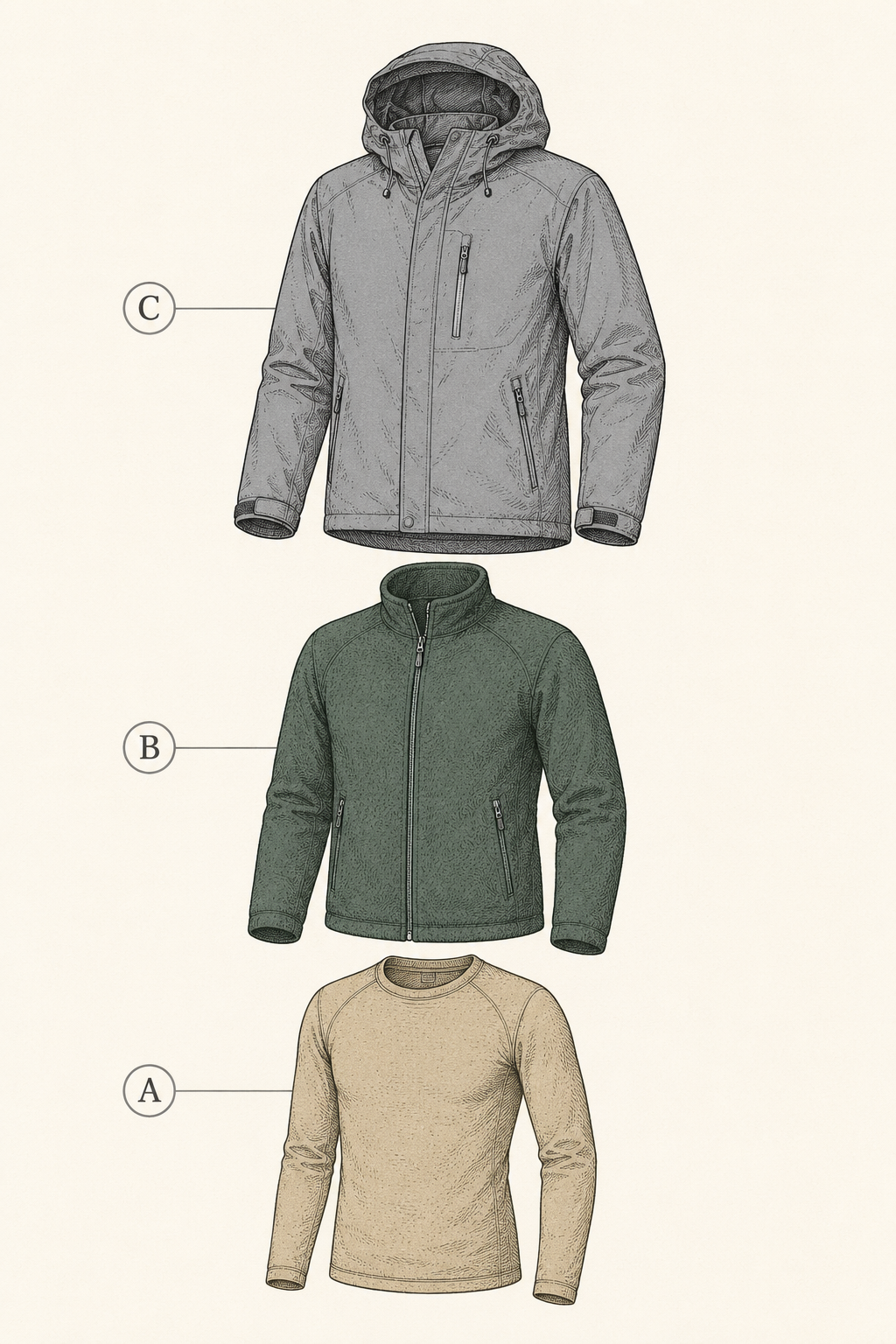
Dress as a system of three jobs, wick, insulate, block, and adjust to conditions by adding or shedding whole layers, not by owning one heavy do-everything jacket.
The base layer wicks sweat off your skin and pushes it outward. The midlayer traps warm air around you. The shell stops wind and rain from stealing that warmth. Three thin jobs beat one thick one because the system tunes itself: climb hard in just the base layer, add the midlayer at a breezy overlook, add the shell when the sky opens. Each combination is a different garment you didn’t have to buy.
The skill is anticipation. Strip a layer at the bottom of the climb, before you sweat; add one the minute you stop, before you chill. Veteran hikers seem to fuss with clothing constantly, and that fussing is the technique, staying just barely cool while moving and just barely warm while still, without ever soaking a layer from the inside.
Base Layers: The Skin You Choose
A base layer is any snug synthetic or merino garment worn next to your skin, for most three-season hiking, a short- or long-sleeve tech shirt.
Snug matters: wicking works by contact, so a flapping-loose shirt moves less moisture. Beyond that, base layers are mercifully simple. Polyester dries fastest and costs least; merino regulates temperature across a wider range and resists odor; blends split the difference. Weight names (lightweight, midweight) track warmth. For summer, lightweight synthetic. For shoulder seasons, midweight, and pack a spare, changing into a dry base layer at the summit is the cheapest luxury in hiking.
Underwear counts as base layer, and the same fiber rule applies. Chafing is moisture plus friction plus miles; synthetic or merino underwear removes the moisture term. Sports bras: synthetic, and consider seam placement under pack straps, a seam that’s invisible on a run can be sandpaper under a shoulder strap at mile eight.
Midlayers: Your Portable Furnace
The default midlayer is a fleece jacket or pullover; the upgrade is a light insulated (“puffy”) jacket with synthetic fill or down.
Fleece is the beginner’s correct first buy: cheap, durable, warm even when damp, and impossible to ruin. Its one weakness is bulk for the warmth. Puffy jackets pack smaller and insulate more per ounce, with the caveat that down fill collapses when soaked and loses most of its warmth until dried, while synthetic fill keeps insulating damp. That single sentence drives the choice: down for cold-and-dry climates and careful people, synthetic for wet climates and everyone’s first puffy. (The same trade-off returns at full volume in the sleeping-bag chapter.)
For your first season, the fleece you may already own is genuinely enough. The puffy earns its price the first time you stand around at a windy viewpoint in the shoulder season, warmth-on-demand, from a bundle the size of a loaf of bread.
Shell Layers: The Weather Wall
A shell is a windproof, waterproof jacket with a hood, sized to fit over your other layers. It lives in your pack on every hike, regardless of forecast, that’s the rule that makes the whole system trustworthy.
Shells come in two families. Waterproof-breathable jackets use membranes that block rain while letting some body vapor escape; they’re the standard choice, at prices that range from reasonable to absurd. Non-breathable rain jackets and ponchos block everything in both directions, clammy on a climb, but cheap, light, and completely rainproof; a perfectly honest first shell. Know the honest limit of both: no shell breathes fast enough to keep you dry inside while climbing hard in warm rain. Manage effort (slow down, vent with the zippers) rather than expecting miracle fabric.
Rain pants join the kit when you graduate to all-weather hiking and overnights; for fair-weather day hikes, they can wait. What can’t wait is the hood, and a brim under it, a ball cap under a shell hood keeps rain off your glasses and is one of hiking’s great unglamorous hacks.
What to Wear Hiking in Summer
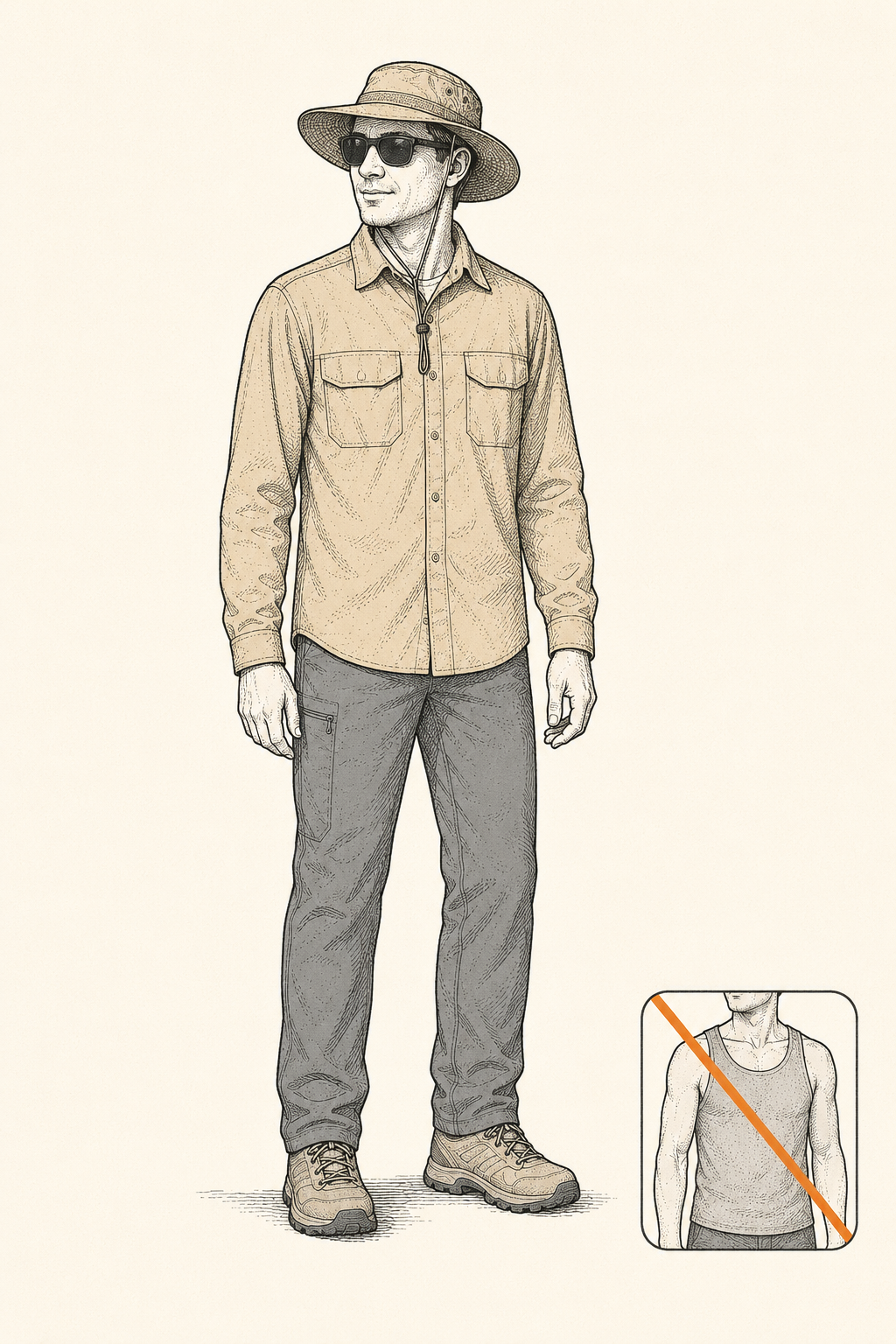
Summer kit: lightweight synthetic shirt, quick-dry shorts or pants, sun hat, sunglasses, plus the warm layer and shell in the pack anyway.
Heat strategy is mostly sun strategy. In strong sun and open country, more coverage often beats less: a loose, light-colored long-sleeve shirt keeps you cooler and burn-free compared to bare arms, which is why desert hikers dress like they’re expecting a formal dinner at noon. Sun-protective clothing carries UPF ratings; a UPF 50 shirt blocks about 98 percent of UV. Sunscreen (SPF 30 or higher) covers what fabric doesn’t, and at elevation this is not cosmetic advice; UV intensifies as the air thins, and reflects off snow and pale rock from below. Chapter 22 covers heat illness; the clothing contribution is shade you can wear.
The counterintuitive item in the summer pack is the warm layer, and it stays. Summits are windy, afternoons build storms, and a twisted ankle that delays you into evening changes the temperature question entirely. The mountains do not read the calendar.
What to Wear Hiking in Cold Weather
Cold-weather hiking is the full three-layer system worn deliberately: midweight base top and bottom, real midlayer, shell, plus warm hat, gloves, and warm socks, with spares of the small items in the pack.
The classic cold-day error is overdressing at the trailhead. You should start slightly cold; ten minutes of climbing will fix it. If you start toasty, you’ll sweat, and sweat is the enemy from Chapter 22 wearing a friendly disguise. Strip before the climb, layer up the moment you stop, the anticipation game again, played for higher stakes.
About heads: you may have heard you lose half your body heat through your scalp. That’s a myth traced to a misread military experiment, the head accounts for roughly 7–10 percent of surface area and loses heat about proportionally. Wear the hat because it’s efficient (easy on, easy off, weighs nothing), not because your head is a magic chimney. Extremities go numb first not because they leak heat fastest but because the body triages blood flow toward the core when it’s losing the overall heat battle, which is why cold fingers are information, not just discomfort: your whole system is running a deficit. Add a layer, eat something, keep moving.
Hats, Gloves, and Small Comforts
Round out the clothing kit with the small items that punch above their weight: a warm beanie, light gloves, spare socks, and sunglasses with real UV protection.
The beanie-and-gloves pair costs little, weighs a few ounces, and extends every other layer’s range by several degrees, they go in the pack in every season except deep summer, and even then, see “summits, windy,” above. Sunglasses are eye safety, not fashion, anywhere the light is strong: high country, snow patches, long water crossings. A neck gaiter is the utility infielder, headband, dust mask, sun collar, emergency hat. None of this is exciting. All of it is what comfortable hikers are wearing while cold hikers describe their character-building experience.
Trail Notes
- One rule over all: synthetic or wool everywhere, cotton nowhere that touches you.
- Dress in three jobs, base wicks, mid insulates, shell blocks, and tune by whole layers.
- The shell and a warm layer ride in the pack on every hike, in every season, regardless of forecast.
- Anticipate: strip before the climb, add the second you stop. Sweat-soaked layers are self-inflicted weather.
- Summer is a sun problem: brim, loose long sleeves, UPF, SPF 30+. Coverage cools.
- Cold weather: start slightly cold, carry spare hat/gloves/socks, and treat cold fingers as a system warning.
Rookie Mistakes
- The cotton hoodie. Comfortable in the car, catastrophic in the rain. It stays home.
- Buying one big heavy jacket instead of layers. It’s always too much or too little, and you can’t climb in it.
- Trusting the trailhead temperature. You’re dressing for the summit, the wind, and the hour after sunset, not the parking lot.
- Hiking in yesterday’s sweaty base layer on a cold morning. Damp fabric next to skin starts the day with a heat debt.
- Leaving the rain shell home because the app showed a sun icon. The shell is not a rain accessory; it’s the system’s insurance policy.
FAQ
What kind of clothing is best for hiking? Synthetic (polyester, nylon) or merino wool layers: a wicking base layer, a fleece or light insulated midlayer, and a waterproof shell. Ordinary athletic clothing from any store works fine if it’s non-cotton. Fit matters more than brand, snug base, roomy shell, everything comfortable under a pack’s straps.
What should you not wear while hiking? Cotton anything against your skin (shirts, socks, jeans), brand-new unbroken footwear, slick-soled shoes, and anything too tight to layer over or under. Denim is the classic offender, heavy when dry, heavier when wet, and slow to forgive either.
Is there a dress code for hiking? No, trails don’t check outfits, and you’ll see everything from technical kits to gym clothes. The only “code” is functional: non-cotton layers, sun protection, and footwear with grip. Wear what lets you move, and nobody (including the weather) will object.
What’s the difference between a $30 rain jacket and a $300 one? Mostly breathability, weight, and durability, not waterproofness. The cheap jacket keeps rain out but traps sweat; the expensive one vents better and packs smaller. For fair-weather day hiking, cheap is a rational choice. Upgrade when you start hiking in sustained rain on purpose.
Do I really need the warm layer on a hot day? Yes. It insures against the three ways a hot day ends cold: wind at elevation, afternoon storms, and unplanned delay into evening. A fleece weighs under a pound (450 g) and rides unnoticed at the bottom of the pack, the premium is trivial and the payout, when it comes, is enormous.
Read offline
The whole book as one PDF — every chapter, every diagram.