Chapter 8
The Floor Between You and the Ground
Sleeping pads
The sleeping pad is the most underrated piece of gear in a beginner’s kit, and the most commonly blamed for problems it didn’t cause. People spend big on a warm bag, skimp on the pad, and then shiver, because the ground, not the air, is what steals their heat at night. The pad is half your sleep system. This short chapter makes sure it pulls its weight.
Why You Can’t Sleep Directly on the Ground
You need a sleeping pad for two separate jobs: cushioning and, more importantly, insulation. The ground is a heat sink, lie on it in a bag and it conducts your body heat straight out through the crushed-flat insulation beneath you, no matter how warm the bag is rated.
This is the fact that reframes the whole sleep system. The insulation under you does almost nothing, your body weight crushes it flat, and flat insulation doesn’t trap air. So the ground is in direct thermal contact with you through a bag that’s failing at exactly the spot you’re lying on. The pad’s job is to slide a layer of trapped air (or foam) between you and that heat sink. Skip the pad or bring a poor one, and a 20°F bag sleeps like a 40°F bag. This is why last chapter said half of “my bag wasn’t warm enough” is really “my pad wasn’t.”
Comfort is the pad’s second job and the one beginners notice first, the difference between sleeping on cushioned support and waking on hard, root-studded ground at 2 a.m. Both jobs matter. The insulation one matters more, and it’s measured by a single number.
What Sleeping Pad R-Value Means
A pad’s R-value measures how well it insulates you from the ground, higher means warmer. The numbers are additive and standardized, so an R-value of 4 blocks twice as much heat loss as an R-value of 2, and you can compare any two pads directly.
R-value is the pad’s single most important spec, and thanks to a shared testing standard (ASTM F3340) it now means the same thing across every brand, a genuine improvement over the old era of marketing guesses. Read it the way you read a bag’s temperature rating: it’s the number that tells you whether you’ll be warm.
The additive part is useful in the field: stack two pads and their R-values sum. A common cold-weather trick is a foam pad (say R-2) under an inflatable (R-3.5) for a combined R-5.5, and the foam protects the inflatable from ground punctures as a bonus.
What R-Value Do You Need?
For three-season backpacking (spring through fall), aim for a pad with an R-value of about 3 to 4. For summer-only warm-nights use you can go lower (R-2ish); for cold and winter camping you want R-5 and up.
Here’s the quick guide:
| Conditions | Target R-value |
|---|---|
| Warm summer nights only | ~2 |
| Three-season (the versatile default) | 3–4 |
| Cold shoulder-season / light winter | 4–5 |
| Winter / snow | 5+ |
Like a sleeping bag, buy for the cold end of your plans, not the average, an R-4 pad is the sensible three-season default because it covers chilly nights without much weight penalty, and it’s the number most first-time backpackers should look for. Remember pads stack, so you can extend a summer pad into colder weather with a cheap foam pad underneath rather than buying a second expensive one.
The Three Types of Sleeping Pad
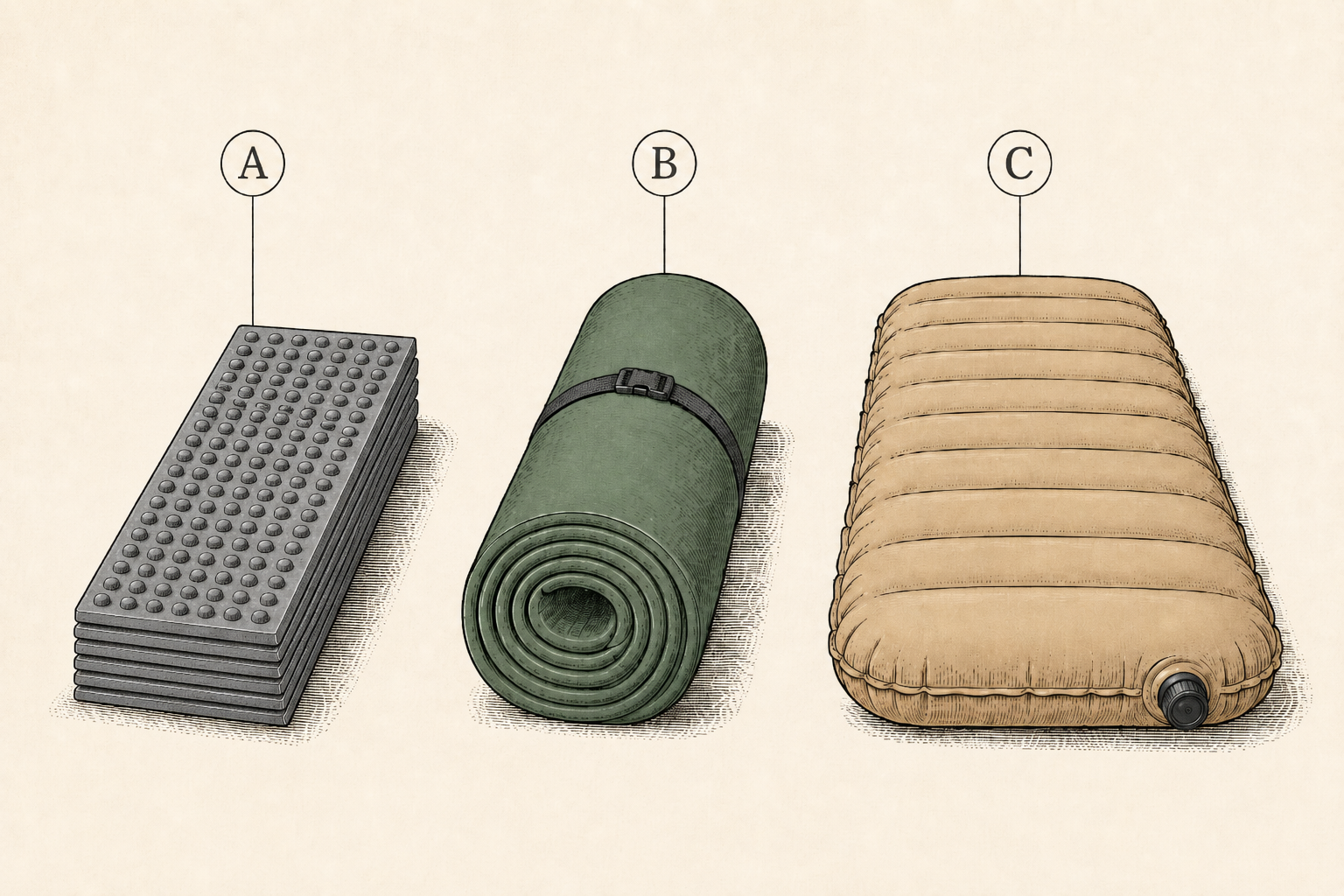
Backpackers choose among three pad types: closed-cell foam (cheapest and indestructible), self-inflating (comfortable and durable), and air pads (lightest and most comfortable, but puncturable). Each trades comfort, weight, warmth, and reliability differently.
Closed-cell foam, a dense foam mat, often accordion-folding, is cheap, light, warm-enough (around R-2), and literally cannot fail: no valve, no puncture, no worry. It’s thin, so it’s the least comfortable, and bulky (it rides outside the pack). It’s the bombproof beginner pad and the ideal backup.
Self-inflating pads, open-cell foam in an airtight shell, you unroll, open the valve, and they draw in air on their own (a few breaths tops them off). Comfortable, warm, durable, and moderately packable, but heavier and pricier than foam. A reliable all-rounder.
Air pads, inflated entirely by lung (or a pump sack), are the lightest and most comfortable, and modern ones layer internal insulation for high R-values. The catch is in the name: they can puncture, so they demand a repair kit and a little care about where you lie down. Most weight-conscious backpackers land here and simply carry the patch kit.
Comfort, Weight, and Sleeping Style
Beyond R-value, choose a pad by thickness (more cushion, especially for side sleepers), length (a full-length pad insulates your feet; a short pad saves weight but leaves legs on the ground), and width (standard pads are narrow, restless sleepers roll off).
Sleeping style matters more than catalogs admit. Side sleepers need more thickness (2.5–4 inches / 6–10 cm) so hips and shoulders don’t bottom out; back sleepers get away with thinner pads. Restless sleepers should consider a wide pad, because rolling onto cold ground at night undoes everything the pad is for. Length is a weight lever: a full-length pad keeps your feet warm and cushioned; a three-quarter pad saves ounces and lets you rest your feet on your empty pack. There’s no universally correct pad, there’s the one that matches how your body actually sleeps, which you’ll learn on your first couple of trips.
Care and Field Repair
Protect an inflatable pad from punctures, clear the ground before laying it down, keep it away from your stove and campfire, and carry the patch kit that comes with it. Store all pads unrolled or loosely, valve open, like your sleeping bag.
The failure that ruins a trip is a pad that deflates at midnight, and it’s almost always preventable: sweep away the sharp sticks and stones, put a foam pad or your pack’s back panel under an air pad on rough ground, and never set an inflatable near heat. If it does puncture, the fix is easy, most pads include a patch kit, finding the leak is a matter of listening or dunking a section in water and watching for bubbles, and a patched pad is usually as good as new. Store pads with the valve open and unrolled so the foam doesn’t take a permanent set, exactly as you store the bag: loft, once lost, doesn’t come back.
Trail Notes
- The pad insulates you from the ground’s heat sink, it’s why a warm bag still sleeps cold without a good pad.
- R-value is the key spec, standardized (ASTM F3340) and additive. Three-season target: R-3 to R-4.
- Buy for the cold end; stack a foam pad under an air pad to add R-value and puncture protection.
- Three types: closed-cell foam (cheap, unkillable), self-inflating (comfy all-rounder), air pad (lightest, plushest, puncturable).
- Match thickness and width to how you sleep, side sleepers need more cushion, restless sleepers need width.
- Clear the ground, keep pads from heat, carry the patch kit, store unrolled with the valve open.
Rookie Mistakes
- Cheaping out on the pad after splurging on the bag. The ground steals more heat than the air. The pad is half the system.
- Ignoring R-value. It’s the pad’s temperature rating. A plush-but-cold pad is a beautiful way to shiver.
- A thin pad for a side sleeper. Hips and shoulders bottom out; you wake on rock. Thickness is comfort.
- Setting an air pad on the sticks and stones you didn’t clear. The midnight deflation is nearly always self-inflicted.
- Storing it rolled tight. Same as the bag, the foam takes a set and never fully recovers.
FAQ
What is a good R-value for a sleeping pad? For three-season backpacking, an R-value of about 3 to 4 is the versatile default, warm enough for chilly nights without excess weight. Summer-only sleepers can use ~2; cold and winter camping calls for 5 and up. Buy for the coldest nights you’ll actually face.
How important is the sleeping pad R-value? Very, it’s the pad’s warmth spec, and warmth from the ground up is where most cold nights are won or lost. A high-rated sleeping bag on a low-R pad still sleeps cold, because your body crushes the bag’s underside flat and the ground conducts heat straight out. Match the pad’s R-value to your conditions.
Is closed-cell foam or an inflatable pad better? Different trade-offs. Closed-cell foam is cheap, light, warm-enough, and can’t fail, great as a first pad or a backup, but thin and bulky. Inflatable air pads are far more comfortable and pack smaller, with higher R-values available, but can puncture and cost more. Many hikers carry a foam pad under an air pad for warmth and puncture insurance.
Can you put two sleeping pads together? Yes, and R-values add. A common cold-weather setup is a closed-cell foam pad (about R-2) under an inflatable (about R-3.5) for a combined R-5.5, warmer, and the foam shields the air pad from ground punctures. Stacking is the cheapest way to extend a summer pad into colder weather.
What sleeping pad do I need for winter? For snow and genuine cold, target an R-value of 5 or higher. The easiest path is often a dedicated high-R air pad, or a foam pad stacked under your three-season inflatable to reach the number. The ground in winter pulls heat aggressively, so this is not the place to economize.
Read offline
The whole book as one PDF — every chapter, every diagram.