Chapter 1
First Steps
Your first day hikes
Every backpacker you will ever meet, including the sun-cured veterans crossing entire states on foot, started with a short walk on an easy trail. Day hiking isn’t the kiddie version of backpacking. It’s the engine room of it: the place where your legs, your judgment, and your gear opinions all get built. This chapter gets you onto a trail this week.
What Counts as a Day Hike?
A day hike is any hike you finish before dark, carrying only what you need for the day, water, food, and a small margin of safety gear. No tent, no stove, no forty-pound pack.
That definition hides how much range it covers. A flat two-mile loop around a reservoir is a day hike. So is a twelve-hour push up a mountain and back. The gear list barely changes between them; what changes is you. The whole progression of this sport is stretching what “before dark” can contain, and the stretching happens naturally if you keep showing up.
Day hiking is also a complete destination in itself. Plenty of lifelong hikers never sleep on the ground, and they aren’t doing it wrong. If you work through Part I and decide that coming home to your own bed is the correct end to a day outdoors, you’ll get no argument from this book. But if a night under the sky is calling, day hikes are where you earn it.
How Long Should a Beginner Hike?
Plan 3 to 5 miles (5–8 km) for your first hike, on a marked trail with modest elevation change. That’s two to three unhurried hours, long enough to feel like you did something, short enough that a problem stays an inconvenience.
The number one predictor of whether someone hikes a second time is how the first one felt at the end. Five miles sounds unimpressive in a culture that celebrates marathons, but hiking miles are not sidewalk miles. Dirt, rocks, and grade recruit muscles that pavement never asks about, and the last mile of any hike has a documented tendency to be twice as long as the map claims. Finish your first hike feeling like you had another mile in you. That leftover mile is what brings you back.
If you’re already fit from another sport, resist the urge to skip ahead. Cardio transfers; feet, ankles, and downhill legs don’t. Runners are famous for blistering spectacularly on their first real descent. Give your connective tissue two or three easy hikes to catch up with your lungs.
How Long Will a Hike Take?
Estimate one hour for every 3 miles (5 km), then add 30 minutes for every 1,000 feet (300 m) of climbing. Then add your breaks on top.
That formula is a 130-year-old rule of thumb called Naismith’s rule, and it remains the standard back-of-envelope math for trip planning. It describes a reasonably fit adult walking steadily, which, on your first hikes, is not quite you. Beginners on real terrain average closer to 2 miles (3 km) per hour once photo stops, snack stops, and what-is-that-bird stops are counted honestly. Use 2 mph for your first outings and let the data correct you.
The reason to run this math every single time isn’t precision, it’s daylight. “How long will it take” is really “when must I start.” Check the sunset time, work backward through your estimate, add an hour of cushion, and you have your start time. Hikers who do this simple arithmetic almost never end up walking out by phone-light. Hikers who don’t, do.
Safety Tell someone where you’re going and when you’ll be back, every hike, even short ones. A two-sentence text (“Maple Ridge loop, back by 4, I’ll text you”) is the single cheapest piece of safety equipment that exists. Chapter 14 turns this into a full trip-plan habit.
Where to Find Beginner-Friendly Trails
Start with the parks closest to you: city and county open spaces, state parks, and the nearest national forest. Between them, most people in North America live within a short drive of more marked trail than they could hike in a year.
Finding them has never been easier. Trail apps and websites let you filter by distance, elevation gain, and difficulty, then read recent reports from people who walked the trail last weekend, invaluable for spotting washouts, snow, or full parking lots. (Chapter 16 covers the apps properly, including the offline-map habit that turns your phone into real navigation gear.) Land-agency websites list official conditions and closures. And the staffed visitor center at any state or national park remains the most underrated trail-finding technology available: describe your experience level honestly and ask what they’d recommend. Rangers answer that question all day and are good at it.
What to look for in a first trail, in order: marked and maintained (signed junctions, an actual tread), loop or out-and-back shape (no shuttle logistics), under 700 feet (210 m) of total climbing, and some reason to be there, a lake, a viewpoint, a waterfall. Morale is a navigation instrument. You will walk farther, happier, toward something.
How to Build Up Distance
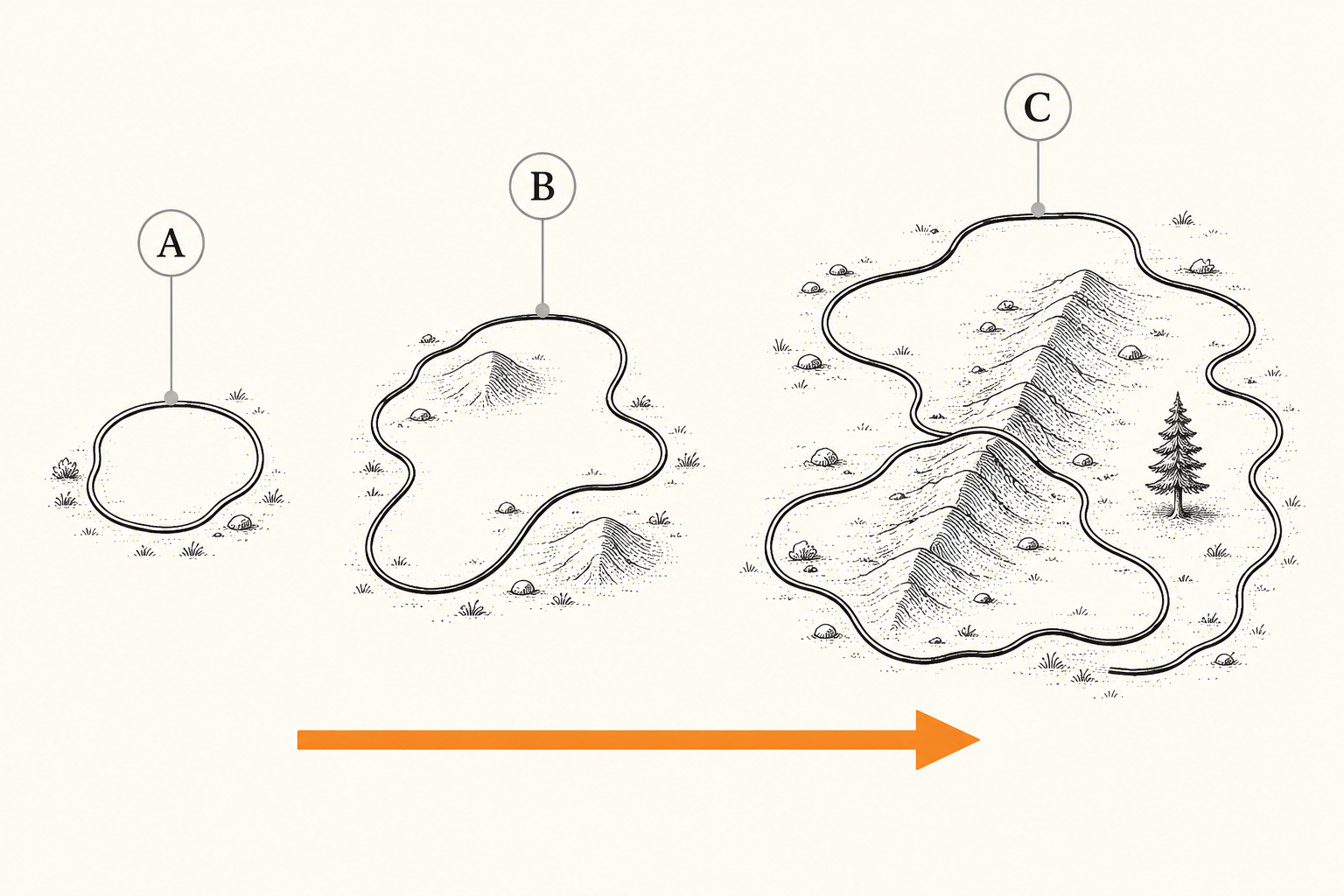
Repeat a distance until it bores you, then add a third. Boredom, not soreness, is the green light.
The ladder looks like this. Stage one: 3–5 miles (5–8 km) on mostly flat ground, repeated until it’s easy. Stage two: 5–8 miles (8–13 km) on rolling terrain with up to about 1,000 feet (300 m) of gain. Stage three: 8–12 miles (13–19 km) with sustained climbing. A hiker who is comfortable at stage three can walk essentially anywhere a trail goes, given enough daylight, and is, not coincidentally, fit enough to carry an overnight pack (Part II’s project).
Two habits make the ladder work. First, hike regularly rather than heroically, every week or two beats one monster outing a season, because the adaptations live in tendons and joints that strengthen slowly. Second, log what you did: trail, miles, gain, time, and one sentence about how it felt. Four hikes in, your log becomes a better planning tool than any formula, because it predicts you.
What Hiking Actually Feels Like
Here’s the expectation-setting nobody does, delivered with love: hiking is repetitive, and that’s the point.
The first mile is often genuinely uncomfortable, breathing hard, wondering why you came. Around the second mile something downshifts. Your stride finds its metronome, the mental chatter thins out, and time starts moving at a different rate. Hours pass in what feels like minutes, marked off in birdsong and switchbacks. This state is the actual product hiking sells. The lake at the turnaround is just the excuse.
Not everyone loves it immediately. If your first hike feels slow and unglamorous, that’s a normal first response to an activity whose rewards are mostly interior. Give it three trips before you rule on it. And if a hiking friend melts down at the pace, it happens; some people’s nervous systems want more input, pick shorter trails with bigger payoffs and don’t take it personally.
When to Turn Around
Set a turnaround time before you start walking, and honor it no matter where you are on the trail when it arrives.
The arithmetic is simple: whatever time you must be back at the car, subtract the walking time you have left to do, subtract your cushion, that’s your turnaround time. If it arrives when the summit is “just twenty more minutes,” turn around anyway. The summit is a rock. It does not know you, and it will host you some other Saturday.
This discipline matters because nearly every day-hike rescue starts the same way: someone kept going. Fatigue, fading light, and weather all compound at exactly the moment enthusiasm peaks. The turnaround habit, decided in advance, when you were smart and rested, is how you outvote the version of yourself that shows up at hour four, tired and summit-drunk. Weather gets a veto too: building clouds, distant thunder, or a temperature drop are all valid reasons to call it early. The mountains reward people who are easy to reschedule.
Your First Hike, Step by Step
Here is the whole thing, condensed to a checklist you could run this weekend.
- Pick a marked trail of 3–5 miles with under 700 feet of gain. Use an app or ask a ranger; read a recent trip report if you can find one.
- Check the weather the night before and the morning of. A bad forecast is a reschedule, not a challenge. (Chapter 22 explains what “bad” means in the hills.)
- Pack water, snacks, and layers. One liter (34 fl oz) per person minimum for a short hike, the full math is in this chapter’s FAQ and Chapter 4. An extra warm layer and a rain shell ride along even on blue-sky days.
- Wear shoes you already trust with non-cotton socks. Chapter 3 will upgrade your feet properly; for hike one, broken-in athletic shoes on an easy trail are fine.
- Text your plan to someone. Trail, expected return, when to worry.
- Start early and set your turnaround time at the trailhead. Say it out loud. It’s harder to cheat a spoken number.
- Walk at a pace you could hold a conversation at. If you can’t talk, slow down. Drink before you’re thirsty; snack every hour or so.
- At the end, take notes. Miles, time, how your feet feel, what you wished you’d brought. That log is the seed of every good decision in the rest of this book.
Trail Notes
- Day hiking is the foundation, not the warm-up act. Every backcountry skill is built on it.
- First hike: 3–5 miles (5–8 km), modest climbing, marked trail. Finish with a mile still in your legs.
- Plan with Naismith’s rule, 3 miles (5 km) per hour plus 30 minutes per 1,000 feet (300 m) of gain, but budget as a 2 mph (3 km/h) hiker until your log proves otherwise.
- Work backward from sunset to set your start time; set a turnaround time and obey it.
- Tell someone where you’re going. Every hike. No exceptions.
- Progress by repetition: when a distance gets boring, add a third to it.
Rookie Mistakes
- Debuting at ten miles. The soreness isn’t the problem; the blisters and the sworn-off-forever feeling are. Start small on purpose.
- Treating the turnaround time as a suggestion. “Twenty more minutes” is how afternoon hikes become headlamp hikes.
- Racing the trail. A conversational pace covers astonishing distance. A heroic pace covers two miles and then sits down.
- Skipping the weather check because it was sunny at breakfast. Mountain weather is a different jurisdiction. Check it like it’s a flight status.
- Going quiet. Not telling anyone your plan turns a sprained ankle from a bad afternoon into a search operation.
FAQ
How long should a beginner hike? Three to five miles (5–8 km) on a marked trail with under about 700 feet (210 m) of climbing is the sweet spot for a first hike, two to three hours of walking. Repeat that range until it feels easy, then add distance in one-third increments. Finishing with energy left over matters more than any specific number.
What is the best way to start hiking? Pick an easy, well-marked local trail; go with weather checked, water and layers packed, and a friend told; walk it at a conversational pace. That’s genuinely the whole method. Consistency, a hike every week or two, builds trail fitness faster and more safely than occasional big efforts.
Is hiking good exercise? Yes, it’s sustained cardio with built-in strength work. Uneven ground and grade recruit the legs, hips, and core in ways treadmills don’t, and hiking’s intensity self-adjusts: the same trail serves a gentle recovery day or a hard workout depending on your pace and the elevation you choose.
Does hiking help with stress? The combination of rhythmic exercise, natural settings, and time away from screens is consistently associated with lower stress and improved mood, which matches most hikers’ lived experience of coming back mentally quieter. This book won’t lean on the science, one afternoon on a trail makes the argument better than a citation can.
Do I need hiking boots for my first hike? No. On an easy, dry trail, any broken-in athletic shoe with decent tread is fine. What you should not wear is anything brand-new, anything with slick soles, or cotton socks. When your distances grow, Chapter 3 walks through the boots-versus-trail-runners decision properly.
Read offline
The whole book as one PDF — every chapter, every diagram.