Chapter 4
The Day Bag
The Ten Essentials and what to pack
A day hiker’s pack is a small bet about an ordinary day, water, snacks, a warm layer, wrapped around a bigger bet about an extraordinary one. The extraordinary day is rare: a wrong turn that costs three hours, a storm that arrives early, a twisted ankle two miles from the car. But it’s exactly the day the pack was invented for. This chapter builds a day bag that wins both bets and still weighs under ten pounds.
What to Pack for a Day Hike
For a typical half-day hike: water (a liter per person minimum, more by the math below), snacks, a warm layer, a rain shell, sun protection, a headlamp, a small first-aid kit, a map you can use without a signal, and a way to make fire and shelter in a pinch. Charge your phone, and tell someone where you’re going and when you’ll be back.
That paragraph is the entire chapter in miniature, and on an easy local loop it’s honestly enough. The rest of the chapter explains the reasoning framework behind it, the Ten Essentials, plus the water math, the food logic, and the bag itself. The aim isn’t a heavier pack; it’s a considered one. Most of the list weighs ounces. All of it together fits in a school-size backpack with room left for lunch.
The Ten Essentials, Explained as Systems
The Ten Essentials is the standard checklist of survival categories, think of it as ten questions your pack should be able to answer, scaled to the seriousness of the hike.
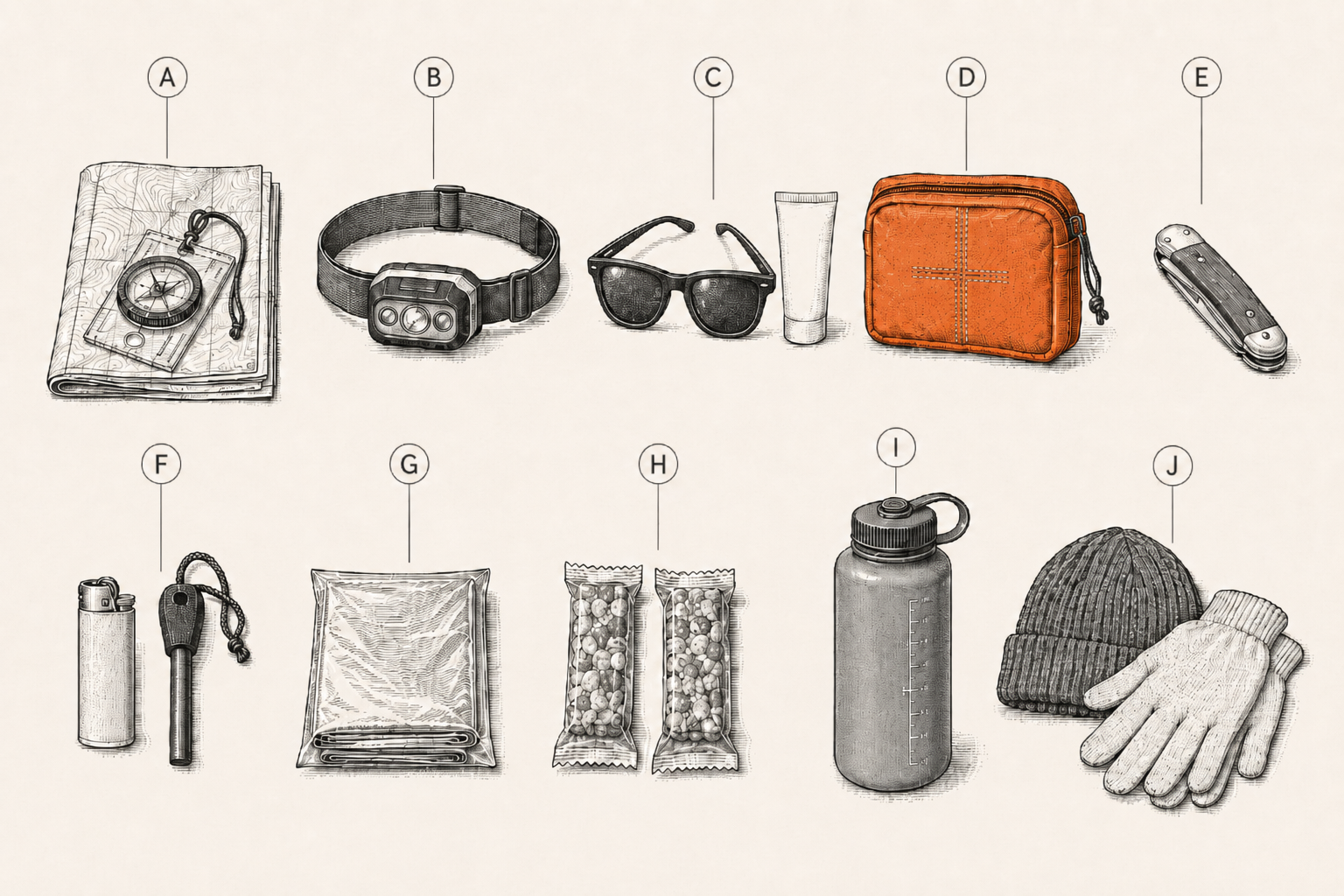
The list began as specific items in the 1930s (compiled by The Mountaineers, the venerable Seattle climbing organization) and has since evolved into a systems list, because the right item depends on the trip. The current canon:
- Navigation, map of the area, and the skill to relate it to the ground; compass and/or a phone app with the map downloaded offline (Chapter 16).
- Headlamp, with charged or spare batteries. The single most-used “emergency” item, because the most common emergency is simply darkness arriving on schedule.
- Sun protection, sunglasses, sunscreen, sun clothing (Chapter 2).
- First aid, a small kit weighted toward what day hikers actually treat: blisters, cuts, scrapes, stings (Chapters 5 and 23).
- Knife, a small knife or multitool, plus repair oddments (a strip of tape wrapped around a water bottle counts as gear).
- Fire, a lighter or waterproof matches, and a firestarter that catches easily. Carried to survive an unplanned night, not to cook lunch.
- Shelter, an emergency space blanket or bivy the size of a deck of cards. The item most often called overkill by people who have never been benighted in wind.
- Extra food, beyond your planned lunch: an extra bar or two that lives in the pack.
- Extra water, or the means to treat more (Chapter 11’s tiny filters and tablets make this nearly free).
- Extra clothes, the warm layer and shell from Chapter 2, plus hat and gloves in shoulder seasons.
Scale is the operative skill. On a two-mile nature loop, your phone, a bar, and a bottle plausibly cover half the list. On a twelve-miler into real terrain, every system deserves a deliberate answer. The list isn’t a purity test, it’s a pre-flight scan that takes thirty seconds once the kit lives permanently in the bag.
How Much Water to Bring Hiking
Plan on about half a liter (17 fl oz) per person per hour of moderate hiking in moderate weather, then round up for heat, altitude, climbing, and bigger bodies. For a three-hour hike, that’s 1.5 liters each; call it 2.
Water is the heaviest thing in your pack, 2.2 pounds per liter (1 kg, exactly; it’s the tidiest number in hiking), which creates a real temptation to under-carry. Respect the temptation, then overrule it. Running out of water turns a pleasant hike into a forced march, degrades your judgment along the way, and is the upstream cause of a remarkable share of trail trouble. Thirst is a lagging indicator: drink on schedule, not on craving, a few swallows every fifteen or twenty minutes beats a chug every hour.
Two refinements as you advance. First, if your route follows reliable water (streams, lakes), a tiny filter (Chapter 11) converts the landscape into your supply and cuts your carry dramatically, this is the classic weight win. Second, on hot or long days, add electrolytes to some of your water; Chapter 17 explains why plain-water-only has limits when you’re sweating hard. Bottles versus hydration bladders is pure preference: bladders encourage sipping, bottles are easier to monitor and refill. Plenty of hikers run one of each.
Food for a Day Hike
Day-hike food is snacks, not meals: bars, trail mix, nuts, dried fruit, jerky, a sandwich if you like ceremony, plus the untouchable emergency bar at the bottom of the pack.
The engine you’re feeding prefers a steady drip to a banquet. A big lunch diverts blood to digestion and produces the famous post-lunch trail coma; a couple hundred calories every hour keeps the legs supplied without the slump. Salty snacks pull double duty by replacing what sweat spends. Beyond that, day-hike nutrition genuinely does not matter much, eat what you’ll actually look forward to, because morale is also a nutrient. The full food chapter (19) arrives when you’re feeding multi-day efforts and every ounce is negotiated.
One habit to install now: all wrappers, cores, and peels go back in the pack. Yes, including the “biodegradable” ones, an orange peel can outlast your enthusiasm for it by a year or more on a dry mountainside. Chapter 21 makes the full case; for now, pack it in, pack it out.
Choosing a Daypack
For most day hikers, a simple 15–25 liter backpack with padded shoulder straps and a sternum strap is ideal. Loaded, it should weigh no more than about 10 percent of your body weight, for most people, 8–15 pounds (4–7 kg) with water.
Liters measure internal volume, and 20 is the day-hike sweet spot: room for water, food, layers, and the essentials kit without room for regrettable extras. Features worth having: a sternum strap (stops strap-slide, steadies the load), a hip belt on the bigger sizes (even a webbing one transfers some weight), side pockets you can reach a bottle in, and one external stash pocket for the shed layer. Features worth skipping at this stage: nearly everything else. The $40 pack and the $180 pack carry a ten-pound load about equally well.
Two honorable alternatives. The school/commuter backpack you already own is a perfectly good first daypack, see Chapter 13’s whole philosophy of not buying things yet. And tiny waist packs handle short strolls where a liter of water and keys are the entire manifest. The moment your carry includes real layers and the essentials, graduate to shoulders.
How to Pack the Day Bag
Pack by access, not by weight: things you’ll want while walking (water, snacks, map, sunscreen) go in outer and top pockets; things you’ll want at stops (layers, lunch, first aid) ride in the main body.
At day-hike weights, load placement barely affects carry, that engineering becomes real in Chapter 15, when the pack quadruples. What matters now is consistency: give every item a permanent address, and repack it to the same address every time. The habit seems fussy until the first time you find your headlamp in five seconds in failing light, at which point it converts to religion. A small dry bag or even a freezer zip-bag around the phone-battery-first-aid cluster cheaply rainproofs the things that mind rain.
Do the pre-flight the night before, not at the trailhead. Trailhead packing is how sunscreen ends up on the kitchen counter, forty minutes away.
Weather Check and Word Left
Two rituals close every packing session: check the forecast for the trail (not your house), and tell someone your plan, route, expected return, when to worry.
The mountain forecast differs from the valley one in temperature, wind, and intent; check the highest elevation you’ll touch, and check again the morning of. What you’re screening for at this stage is simple: thunderstorms, big temperature swings, and anything involving the word “advisory.” Chapter 22 will teach the deeper reading; Chapter 14 formalizes the trip plan. The two-sentence version from Chapter 1, where, when, worry-time, remains the minimum viable message, and it costs nothing.
Safety A phone is a phenomenal safety tool and a terrible sole plan, batteries die, canyons block signal, screens crack on rocks. The Ten Essentials exist so that your safety never depends on one glass rectangle. Carry the phone and the redundancies.
What Not to Bring
Leave behind: heavy extras “just in case” (the essentials already cover the real cases), glass anything, bluetooth speakers (the trail’s one universal etiquette rule), brand-new gear making its debut, and anything you’d be crushed to lose from an unzipped pocket.
The just-in-case impulse deserves a moment of respect before we decline it. It’s the right instinct, uncertainty is real, pointed at the wrong solution. The answer to uncertainty is the systems you’ve already packed, not a third jacket and a cast-iron optimism about your shoulders. Every unnecessary pound converts directly into fatigue, and fatigue is itself a safety cost. The Ten Essentials weigh under three pounds total. Trust the framework; leave the fourth granola flavor at home.
Trail Notes
- The day bag answers ten questions, navigation, light, sun, first aid, knife, fire, shelter, extra food, extra water, extra clothes, scaled to the hike’s seriousness.
- Water math: ~0.5 L (17 fl oz) per hour of moderate hiking, rounded up for heat and climb. Water weighs 2.2 lb (1 kg) per liter; carry deliberately.
- Eat by the hour, not by the meal; salty snacks do double duty; one emergency bar lives in the pack untouched.
- A 15–25 L pack with a sternum strap is plenty; loaded weight ≤ ~10% of body weight.
- Every item gets a permanent address; pack the night before; phone plus redundancies, never phone alone.
- Forecast checked for the trail’s elevation; plan told to a person. Every hike.
Rookie Mistakes
- Carrying fear instead of systems. Three jackets and no headlamp is a common and exactly backward loadout.
- One water bottle for a four-hour July hike. Do the multiplication. It’s the least optional math in this book.
- The phone as the entire safety plan. Navigation, light, and rescue all living in one battery is elegant right up until 15 percent.
- Big trail lunch. The post-sandwich coma is real. Graze hourly instead.
- Packing at the trailhead. That’s where sunscreen, headlamps, and car keys go to get forgotten.
FAQ
What are the Ten Essentials for day hiking? Navigation, headlamp, sun protection, first aid, knife, fire, emergency shelter, extra food, extra water, extra clothes, a systems checklist maintained by The Mountaineers since the 1930s. Scale each system to the hike: minimal on a short local loop, deliberate on a long or remote one.
What should you not bring on a day hike? Heavy just-in-case extras beyond the essentials, glass containers, speakers, valuables you can’t afford to lose, and unbroken-in footwear. If an item doesn’t serve walking, eating, warmth, or safety, it’s paying rent in pounds and giving nothing back.
What’s a good daypack for hiking? A 15–25 liter pack with padded shoulder straps and a sternum strap covers nearly all day hiking; add a hip belt at the larger end. Any sound backpack you already own works to start. Comfortable straps and a bottle pocket you can actually reach matter more than brand or price.
Is a hydration bladder better than bottles? It’s preference. Bladders encourage frequent sipping and carry weight close to your back; bottles are easier to refill, monitor, and clean, and can’t leak into your gear. Many hikers run a bladder for sipping plus one bottle for measuring, and in freezing weather, bottles win outright.
How heavy should a day pack be? Loaded, aim for no more than about 10 percent of your body weight, typically 8–15 pounds (4–7 kg) including water. If yours is heavier, it’s almost always water (fine, drink it down) or just-in-case items (not fine; see the essentials framework).
Read offline
The whole book as one PDF — every chapter, every diagram.