Chapter 11
Clear Water
Filters and water treatment
The clearest, coldest, most beautiful mountain stream can still make you violently ill. That’s the hard truth this chapter is built around, and the good news is that treating water has become light, cheap, and nearly effortless. A modern filter the size of a water bottle turns the whole landscape into your water supply. This chapter explains what you’re protecting against and how to do it right.
Why You Can’t Drink Straight From the Stream
Assume all untreated backcountry water is contaminated, no matter how clean it looks, clarity tells you nothing about the microorganisms in it. The main hazards are protozoa (giardia and cryptosporidium), bacteria, and, in some places, viruses, all of which cause serious gastrointestinal illness.
The disappointment is real: that pristine alpine stream can carry pathogens shed by animals (or people) upstream, and you can’t see, smell, or taste them. The specific threats:
- Giardia, a protozoan parasite, the most common backcountry waterborne illness. It causes giardiasis: severe diarrhea, cramps, bloating, and fatigue, with symptoms appearing one to three weeks after exposure. It’s miserable, lingering, and needs prescription treatment.
- Cryptosporidium (“crypto”), another protozoan, notable because it resists chemical treatment (it has a tough outer shell) far better than giardia does. This one fact shapes which methods you can trust.
- Bacteria (like E. coli, salmonella, campylobacter), present in some water sources, cause of gastrointestinal illness.
- Viruses (like norovirus, hepatitis A), rare in remote North American backcountry, more of a concern where human contamination is likely or when traveling internationally. Most filters do not remove viruses.
The takeaway isn’t fear, it’s routine. Treat every source, every time, and waterborne illness essentially disappears as a risk. It’s one of the easiest safety habits in backpacking to make automatic.
The Four Ways to Treat Water
You can make backcountry water safe four ways: filtering (physically straining out pathogens), chemical treatment (tablets or drops that kill them), UV light (a device that scrambles their DNA), and boiling (heat kills everything). Each has strengths; most backpackers filter, and carry a chemical backup.
Here’s the comparison that drives the choice:
| Method | Giardia | Crypto | Bacteria | Viruses | Notes |
|---|---|---|---|---|---|
| Filter (hollow-fiber) | ✓ | ✓ | ✓ | ✗ | Fast, reusable, no wait, no taste; can clog or freeze |
| Chemical (chlorine dioxide) | ✓ | ✓ (long wait) | ✓ | ✓ | Tiny, light, kills viruses; wait time, slight taste |
| UV light | ✓ | ✓ | ✓ | ✓ | Fast, no taste; needs batteries, clear water only |
| Boiling | ✓ | ✓ | ✓ | ✓ | Foolproof; uses fuel and time |
The pattern to notice: filters handle the common North American threats (protozoa and bacteria) but miss viruses, while chemicals and UV and boiling get everything including viruses. For most North American backpacking, where viruses are a minor concern, a good filter is the simple, satisfying default, pump or squeeze and drink immediately. Carrying a few chemical tablets as a lightweight backup covers a clogged filter and adds virus protection for peace of mind.
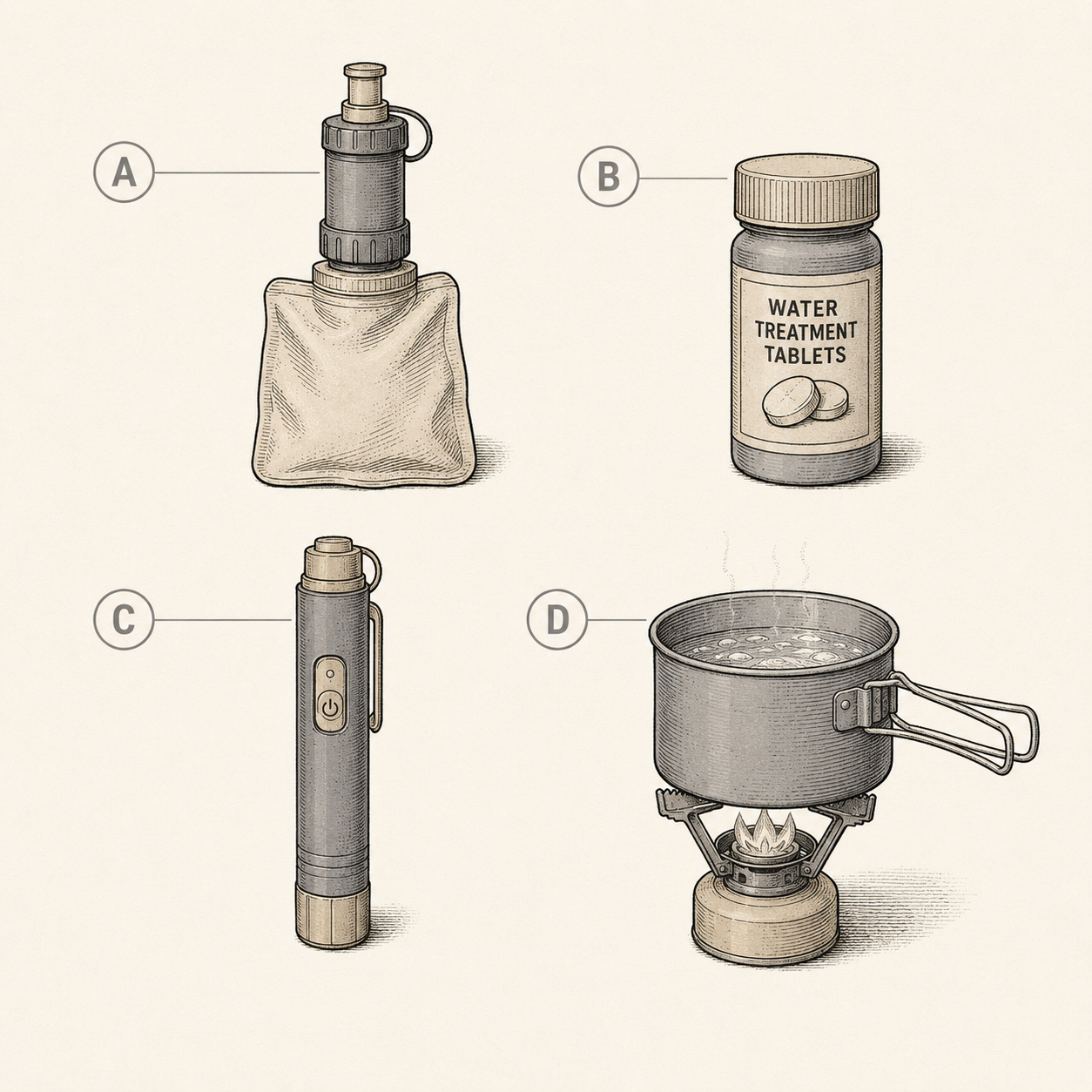
Water Filters: The Beginner’s Default
A modern hollow-fiber filter strains water through microscopic tubes whose pores are small enough to physically trap protozoa and bacteria, giving you safe water instantly, with no wait, no chemicals, and no aftertaste. For most backpackers, it’s the primary treatment method.
The technology is elegant: bundles of hollow fibers with pores around 0.1 micron let water molecules through while blocking anything bigger, which includes giardia, crypto, and bacteria (all far larger than the pores). Because it’s mechanical, there’s no waiting and nothing to taste, you drink the moment you’ve filtered. Filters come in styles: squeeze filters (fill a soft flask, screw the filter on, squeeze, light, cheap, wildly popular), pump filters (draw from any water source, good for shallow or awkward sources), gravity filters (hang a dirty bag, let gravity do the work, great for groups in camp), and straw filters (drink directly, minimalist, but you can’t carry treated water).
Two rules keep a filter working. Keep it clean: backflush it per the instructions when flow slows, or it clogs. And critically, never let a filter freeze once it’s been used. Ice crystals crack the hollow fibers invisibly, destroying the filter’s ability to block pathogens without any visible sign. On cold nights, sleep with a used filter in your sleeping bag. A frozen filter is a broken filter that still looks fine, which is the most dangerous kind.
Chemical Treatment: Light and Thorough
Chemical treatment, chlorine dioxide tablets or drops, kills pathogens including viruses, weighs almost nothing, and makes an ideal backup or ultralight primary. The catch is time: it works on a wait, and against crypto that wait is long.
Chlorine dioxide is the modern chemical of choice because, unlike plain iodine or chlorine, it eventually kills even crypto. Drop a tablet in, wait, drink. The wait times are the thing to respect and they’re printed on the package: roughly 30 minutes for bacteria and viruses, and up to 4 hours to kill cryptosporidium in cold or cloudy water. That crypto wait is why chemicals are usually a backup rather than a sole method, few people want to wait four hours for water. But for a virtually weightless insurance policy in your kit, or an ultralight strategy where you treat at each source and drink at the next, chemicals are excellent.
A historical note, since you may read old advice: iodine was the classic backcountry chemical, but it does not reliably kill crypto, adds a strong taste, and isn’t recommended for pregnant people or long-term use. Chlorine dioxide superseded it. If your information source recommends iodine as a primary treatment, it’s out of date.
UV and Boiling: The Bookends
These two sit at opposite ends of the spectrum: one runs on batteries and electronics, the other on nothing but heat. Both handle everything a filter can’t, including viruses.
A UV pen stirred in a bottle of clear water neutralizes protozoa, bacteria, and viruses in about a minute. It’s genuinely effective, but it needs batteries (that can die in the cold), works only in clear water (silt shields pathogens from the light), and treats one bottle at a time. A fine tool, a risky sole method far from a power source.
Boiling is the oldest and most foolproof method: bring water to a rolling boil for 1 minute to make it safe. At elevations above 6,500 feet (2,000 m), boil for 3 minutes, because water boils at a lower temperature up high. Boiling kills everything, needs no special gear, and is the reliable fallback when a filter clogs or fails, the cost is only fuel and the wait for it to cool. Note the current guidance is 1 minute, not the “3 to 5 minutes” you’ll find in older books; that longer time was always more than necessary and just wastes fuel.
Safety When in doubt, treat. The cost of treating water you didn’t strictly need is nothing; the cost of drinking water you should have treated is a week of giardiasis or worse. Build the habit until it’s automatic: reach a source, treat, drink. Never skip it because the water “looks clean”, clarity and safety are unrelated.
Choosing Your Water System
For a first setup, pick a hollow-fiber squeeze or pump filter as your primary treatment, and carry a small pack of chlorine dioxide tablets as backup. That combination is light, cheap, reliable, and covers every realistic scenario.
The filter handles daily drinking fast and pleasantly; the tablets cover a clogged or frozen filter and add virus protection you’ll rarely need but will be glad to have. This pairing is what a huge share of experienced backpackers actually carry, and it’s a great place to start. Match the filter style to your trips: squeeze filters for solo and light travel, pump filters if your water sources are shallow or hard to reach, gravity systems if you camp with a group and want to treat a lot at once. As with everything, test it at home first, filter a bottle in the kitchen sink so the mechanics aren’t new to you at the stream.
Water Planning: Let Sources Cut Your Load
Because water weighs 2.2 pounds per liter (1 kg), the biggest weight savings in backpacking is planning your route around reliable water and carrying only what you need to reach the next source, treating as you go instead of hauling a day’s supply.
This is the filter’s hidden superpower. When you can treat water anywhere, you stop carrying it everywhere. Study your map and trip reports for streams, lakes, and springs; note where they are and whether they’re seasonal (that clear blue line on the map may be bone-dry in August). Then carry enough to comfortably reach the next reliable source with margin, top off there, and move on. In water-rich terrain you might carry only a liter or two at a time even on a multi-day trip. In dry country (deserts, long ridgelines, late-season high country) the calculus flips and you may carry a lot, but you’ll know you need to, because you planned. Running dry is a serious, avoidable problem; plan water first, and the rest of the pack gets lighter.
Trail Notes
- Assume all backcountry water is contaminated regardless of appearance. Treat every source, every time.
- Main threats: giardia and crypto (protozoa), bacteria, and, rarely, in North America, viruses. Crypto resists chemicals.
- Four methods: filter (fast, no viruses), chemical (everything, but slow on crypto), UV (everything, needs batteries/clear water), boiling (everything, needs fuel).
- Beginner setup: hollow-fiber filter as primary + chlorine dioxide tablets as backup.
- Never let a used filter freeze, cracked fibers fail invisibly. Sleep with it on cold nights.
- Boil 1 minute (3 minutes above 6,500 ft / 2,000 m). Iodine is outdated, it misses crypto.
Rookie Mistakes
- Drinking untreated water because it “looked clean.” Clarity and safety are unrelated. The prettiest streams still carry giardia.
- Letting a used filter freeze. It cracks silently and keeps looking fine while failing. Bag it in your sleeping bag when it’s cold.
- Trusting iodine or a filter to kill everything. Iodine misses crypto; filters miss viruses. Know your method’s gap and cover it.
- Not waiting the full chemical time. Crypto needs up to 4 hours in cold water. Cutting the wait cuts the protection.
- Carrying a day’s water when the trail crosses three streams. Treat as you go. Water is the heaviest thing you can put down.
FAQ
How do you purify water while backpacking? Four proven methods: filter it through a hollow-fiber filter (fast, the common default), treat it with chlorine dioxide tablets (kills everything including viruses, but slow against crypto), use a UV purifier (fast, needs batteries and clear water), or boil it. Most backpackers use a filter as their primary method and carry chemical tablets as backup.
What’s the best water filter for backpacking? A hollow-fiber squeeze or pump filter is the reliable, popular choice, it strains out protozoa and bacteria instantly with no wait or taste. Squeeze filters suit solo and lightweight trips; pump filters handle shallow or awkward sources; gravity systems are great for groups. Match the style to your trips and keep it from ever freezing once used.
How long do you boil water to make it safe? Bring it to a rolling boil for 1 minute at most elevations. Above 6,500 feet (2,000 m), boil for 3 minutes, because water boils cooler at altitude. Boiling kills everything, protozoa, bacteria, and viruses. The old “3 to 5 minutes” advice was always more than necessary and just wastes fuel.
Does a water filter remove giardia and crypto? Yes, a quality hollow-fiber backpacking filter physically strains out both giardia and cryptosporidium, which are far larger than the filter’s pores, along with bacteria. What standard filters do not remove is viruses, which are smaller; for those you need chemical treatment, UV, or boiling. In North American backcountry, viruses are a minor concern.
Do I still need to treat water in cold weather or high mountains? Yes. Cold, clear, high-altitude water can still carry giardia and crypto, these organisms survive in snow and cold streams. Treat it the same as any other source. In freezing conditions, protect a used filter from freezing (which cracks it), and remember chemical treatment takes longer in cold water.
Read offline
The whole book as one PDF — every chapter, every diagram.