Chapter 3
Feet First
Boots, trail runners, and socks
Nothing on a hike matters more than your feet, and nothing announces itself louder when it goes wrong. A sore shoulder is a complaint; a wrecked foot is a veto, it cancels the day, and sometimes the trip. The entire chapter reduces to one commandment: what you wear on your feet must be comfortable every single step, under load, on day one and mile twelve alike. Everything below is engineering in service of that.
Hiking Boots vs Trail Runners: Which Should You Choose?
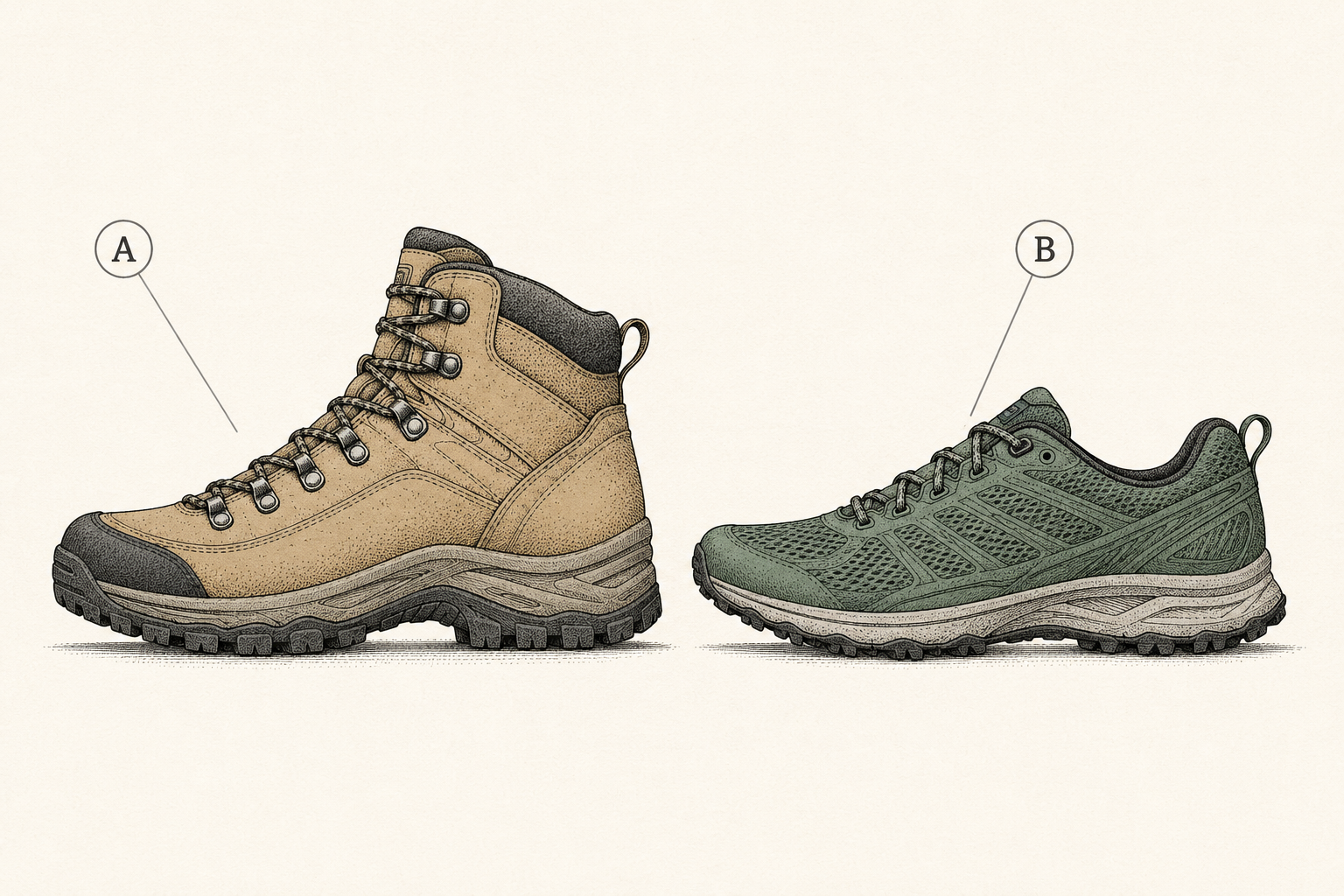
There is no single right answer, modern hikers successfully wear everything from ankle-high leather boots to mesh trail-running shoes. Choose by matching footwear to your terrain, your load, and your own ankles, using the table below as the starting point.
A generation ago this wasn’t a debate: hikers wore boots, full stop. Then long-distance hikers discovered that lighter, faster-drying shoes let them walk farther with less fatigue, and the trail-runner movement went mainstream. Today the split is roughly: boots for rough terrain, heavy packs, and support-hungry ankles; trail runners for maintained trails, lighter loads, and hikers who prize agility and dry-out speed. Both camps summit the same mountains.
| Hiking boots | Trail runners | |
|---|---|---|
| Weight on your feet | More | Much less |
| Ankle support & protection | High, collar, stiff sole, toe cap | Low, relies on your own ankle strength |
| Break-in | Days to weeks | Nearly none |
| Wet behavior | Slower to soak, much slower to dry | Soak fast, dry fast |
| Durability | Often years | Often one to two seasons |
| Best match | Rocky terrain, heavy packs, weak ankles | Maintained trails, light loads, mileage |
The honest beginner’s answer: for your first easy day hikes, the athletic shoes you own are fine (Chapter 1 said so, and it’s still true). When you buy dedicated footwear, most new hikers on most trails are well served by either a light hiking boot or a sturdy trail shoe, the heavy full-leather boot is a specialty tool, not a rite of passage.
When Boots Earn Their Weight
Choose boots when you’ll carry a loaded overnight pack, walk rough or off-camber terrain, hike in sustained wet and cold, or when your ankles have a documented habit of rolling.
What a boot actually buys you: a stiffer sole that shrugs off sharp rock underfoot, a reinforced toe box for the stone you didn’t see, a high collar that adds real (if partial) resistance to ankle rolls, and materials that hold up to years of abrasion. Under a 30-pound (14 kg) pack, feet flatten and tire, and that stiffness converts from “clunky” to “supportive” somewhere around hour three.
The costs are just as real: every ounce on your foot is lifted with every stride, boots run warm in summer, and a soaked boot can stay damp for a full day or more. Waterproof-membrane boots trade even slower drying for dry feet in morning dew and shallow mud, worth it in cool wet climates, sweaty overkill in hot dry ones.
When Trail Runners Win
Choose trail runners when your trails are maintained, your pack is light, and you’d rather step around hazards than armor against them.
The mileage community converged on trail runners for defensible reasons: less weight per stride means measurably less fatigue over a day; mesh uppers vent heat and dry in hours instead of days; zero break-in means the pair fits in the store like it fits at mile 200. The trade: your ankles do their own stabilizing (they get good at it, but only with training), sharp terrain telegraphs through the softer sole, and a pair may wear out in a season or two of heavy use.
If you go this route, go deliberately: strengthen ankles on easy terrain first, and accept that in cold slush the fast-dry shoe becomes a fast-soak shoe. Many hikers eventually own both and pick per trip, boots for the rough overnight, runners for the summer day loop. Feet are allowed to have a wardrobe.
How Should Hiking Boots Fit?
A properly fitted boot holds your heel still, leaves a thumb’s width (about half an inch / 1.3 cm) ahead of your longest toe, and pinches nowhere, evaluated late in the day, in your actual hiking socks, under weight.
Feet swell with hours and load; a boot fitted to your fresh morning foot is a half-size too small by afternoon on the trail. So shop in the afternoon, bring (or buy) the socks you’ll hike in, and walk the store’s incline ramp if it has one. Downhill is the exam that matters: if your toes touch the front on the ramp, they will hammer the front for every descending mile, and that’s how hikers lose toenails. Heels should stay planted when you walk, a heel that lifts is a blister subscription (Chapter 5 will bill you).
Sizing quirks worth knowing: hiking footwear often fits best a half to full size above your street shoes; widths exist and matter; and lacing technique can rescue a marginal fit, a “heel-lock” wrap at the top eyelets pins a lifting heel, and skipping an eyelet relieves a pressure point. A good outdoor shop knows these tricks. Use one for your first pair, be honest about your plans, and try on ruthlessly. Never order your first hiking boots blind off the internet; order your third pair that way, when you know your fit.
How to Break In Hiking Boots
Break in boots progressively: hours around the house, then errands and neighborhood walks, then a short hike, then a loaded hike, watching for hot spots at every stage.
Modern light boots and trail shoes need little of this ceremony; stiff leather boots need all of it. The break-in is mutual: the boot’s materials soften at your flex points while your feet toughen at the friction points, and the process can’t be rushed by wishing. The house stage matters for a boring reason, most retailers accept returns on boots worn only indoors, so your first two evenings are a free extension of the fitting room.
The one non-negotiable: never take brand-new footwear on a long hike. It’s the most reliably regretted decision in the sport, so common it’s practically a heritage tradition. Any hot spot during break-in is data, re-lace, re-sock, or return, but don’t assume it will “wear in.” Discomfort at hour two becomes injury at mile ten.
Hiking Socks: The Half of Footwear Everyone Skips
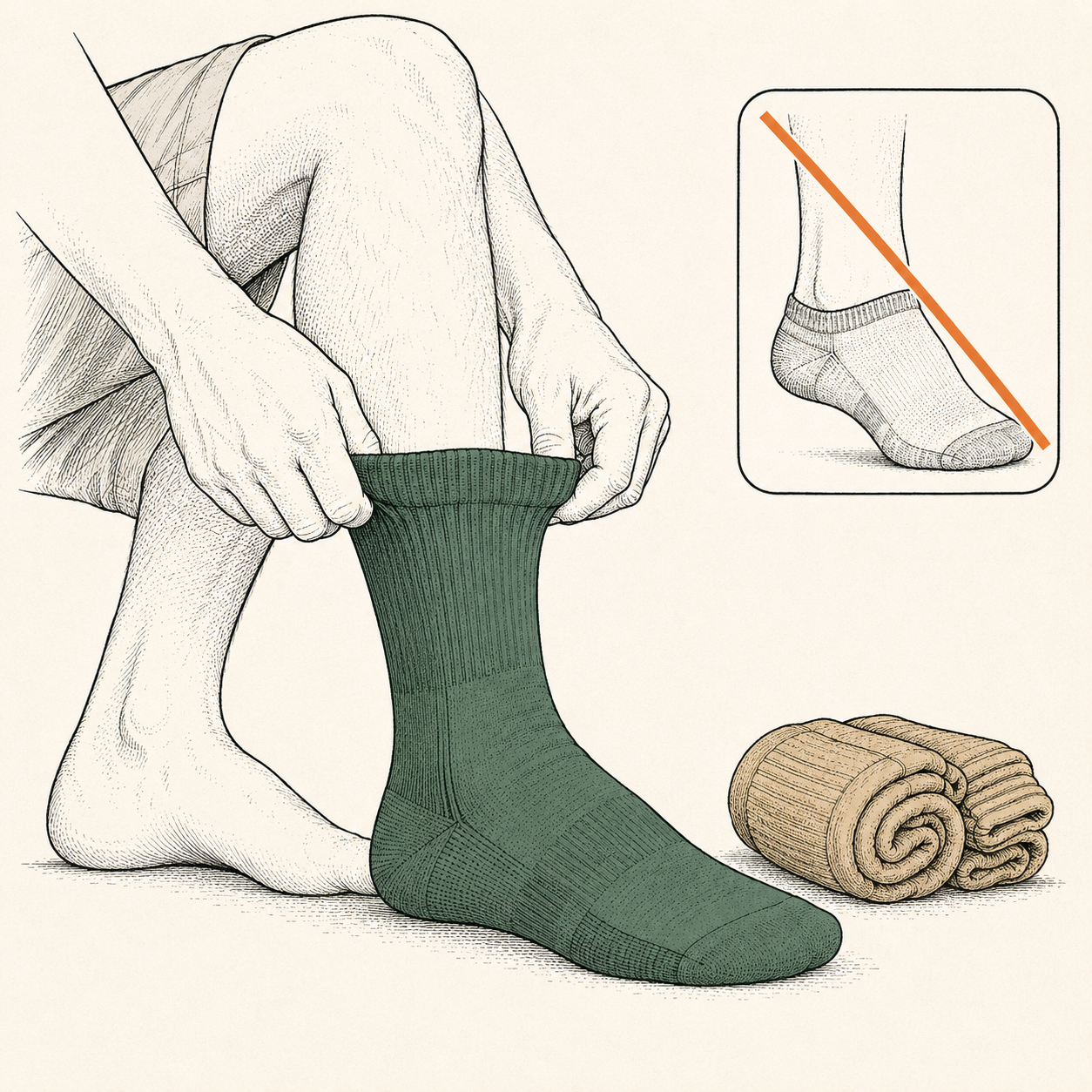
Wear merino wool or synthetic hiking socks, matched in thickness to your footwear’s fit, and never cotton, which holds sweat against your skin and manufactures blisters.
Socks are half the footwear system and a tenth of the budget, which makes them the best money-per-comfort purchase in hiking. Wool and synthetic hiking socks wick moisture, cushion where feet actually land, and keep insulating when damp. Cotton athletic socks do the opposite on every count; they are the single most common cause of first-hike blisters and the cheapest problem in this book to eliminate.
Thickness is a fit variable, not just a warmth one, a thicker sock effectively shrinks the boot a half size. Buy socks and boots as a set and change either with awareness of the other. Carry a spare pair on any hike past a few miles: changing into dry socks at lunch resets your feet’s moisture clock and feels disproportionately wonderful. Wet socks wrung out and clipped to the pack dry as you walk.
Do You Need Sock Liners?
Probably not to start, modern single-layer hiking socks have made thin liner socks optional. Liners remain a targeted tool for blister-prone feet.
The old two-sock doctrine (thin liner under padded outer, so friction happens between fabrics instead of on skin) solved a real problem in the stiff-boot era, and it still works. But today’s snug-fitting merino blends manage moisture well enough that most hikers run one good sock and no liner. Try the simple system first. If you blister anyway, some feet just do, add liners before you add gadgets; the fabric-on-fabric trick is still sound mechanics, and Chapter 5 has the rest of the anti-blister arsenal.
Test Everything Before It Matters
Before any long or loaded hike, rehearse your exact foot system, these boots, these socks, this pack weight, on a short local trail.
Footwear that’s fine unloaded can fail under a pack: feet spread, pressure maps shift, and seams you never noticed introduce themselves. The pre-trip shakedown hike is the cheapest insurance in the sport, and it tests you as much as the gear. Every element of your kit earns trail trust the same way, nothing debuts on the big day. (This principle returns at full scale in Chapter 24, where the whole overnight kit takes its shakedown.)
Trail Notes
- Footwear’s one law: comfortable every step, under load, from day one. Nothing else about a shoe matters if that fails.
- Boots for rough terrain, heavy packs, and rolling ankles; trail runners for maintained trails and light loads. Both are legitimate; many hikers own both.
- Fit late in the day, in hiking socks, with a thumb’s width (½ in / 1.3 cm) of toe room and a heel that doesn’t lift. Downhill is the real test.
- Break in progressively, house, street, short hike, loaded hike. New footwear never debuts on a long hike.
- Socks are half the system: merino or synthetic, matched thickness, spare pair in the pack. Cotton socks are banned.
- Shake down the exact foot system before every big outing.
Rookie Mistakes
- Buying boots for the hiker you plan to become, the burly mountaineering boot for the gentle county trail. Match the tool to the actual job.
- Morning-foot fitting. The boot that fit at 9 a.m. in thin dress socks is the one hammering your toes on Saturday’s descent.
- Assuming pain will break in. Materials soften; geometry doesn’t. A wrong-shaped boot at hour one is a wrong-shaped boot forever.
- Spending $200 on boots and $3 on cotton socks. The sock touches your skin; the boot only touches the sock.
- Waterproof everything, everywhere. In hot, dry country, membrane boots are portable saunas. Ventilation is also a feature.
FAQ
What’s better, trail runners or hiking boots? Neither is better; they’re different bets. Boots bet on protection, support, and durability, best under heavy packs, on rough terrain, and for weak ankles. Trail runners bet on lightness, ventilation, and fast drying, best on maintained trails with lighter loads. Match the bet to your terrain and body.
Can you use regular running shoes as hiking shoes? On easy, dry trails, yes, a broken-in road runner with decent tread handles a beginner hike fine. Their limits show up in mud, on loose descents, and under pack weight, where trail-specific outsoles and firmer midsoles earn their keep. Upgrade when your terrain outgrows the shoe, not before.
How much toe room should hiking boots have? About a thumb’s width, roughly half an inch (1.3 cm), between your longest toe and the front, measured standing, late in the day, in hiking socks. Toes should never contact the front on a downhill ramp. Heel movement is the opposite check: planted, with minimal lift.
Do waterproof hiking boots keep your feet dry? In dew, drizzle, and shallow mud, yes. In sustained rain, deep water, or your own sweat, no, water eventually enters over the collar or from inside, and membrane boots then dry very slowly. In wet-cold climates they’re worth it; in hot-dry ones, ventilated non-waterproof footwear plus spare socks usually wins.
How many pairs of socks do I need for a day hike? Two: one worn, one spare. Change at the halfway point if your feet are damp, and wring out and air-dry the first pair on your pack. For overnights the formula extends, a worn pair, a spare, and a dedicated dry pair that only ever sleeps.
Read offline
The whole book as one PDF — every chapter, every diagram.