Chapter 7
The Warm Cocoon
Sleeping bags
A backpacking trip lives or dies on sleep. Hike ten miles, make camp, cook a decent dinner, and then shiver through the night in a bag that isn’t warm enough, and the whole trip turns into an endurance test you can’t wait to end. The sleeping bag is one of the “big three” that dominate your pack’s weight and your comfort. Getting it right is mostly about reading two numbers honestly.
What Kind of Sleeping Bag Do You Need?
For backpacking you want a lightweight mummy-shaped bag rated to the coldest night you’ll realistically face, for most three-season use, a bag rated around 20°F (−7°C). Mummy shape, appropriate rating, and packable weight are the three things that matter; everything else is refinement.
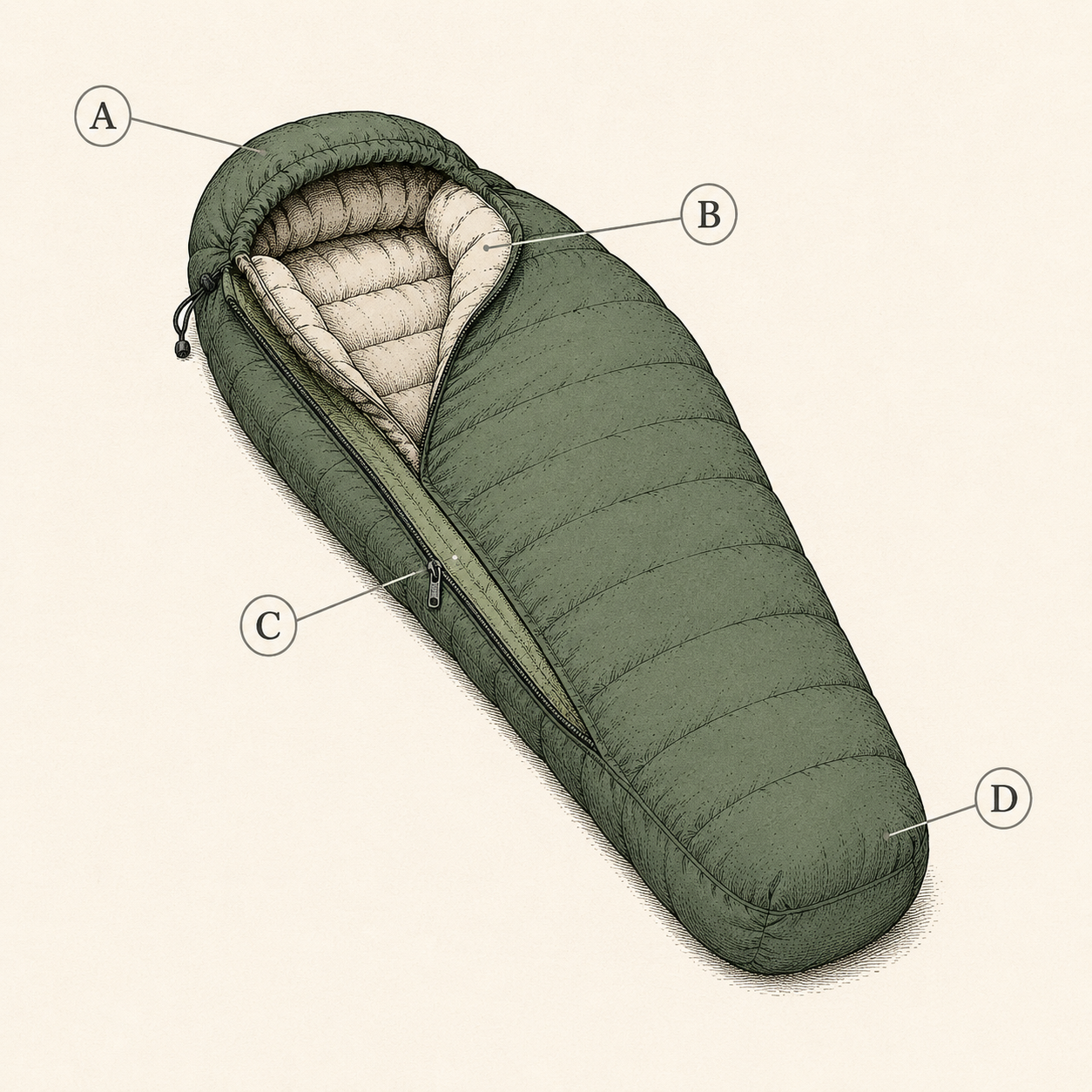
Forget the rectangular bags from childhood sleepovers. They’re heavy, bulky, and leak heat through all that extra space. A mummy bag tapers from shoulders to feet and adds a hood that cinches around your head, so there’s less air for your body to heat and less bag to carry. It looks confining and sleeps warm, that’s the trade, and for backpacking it’s the right one. The rating and fill choices below fit the bag to your climate and budget.
How to Read Sleeping Bag Temperature Ratings
A bag’s temperature rating is the lowest temperature at which it’s designed to keep a sleeper functional, but modern ratings come in two numbers, and you need to read the right one. Under the current ISO standard, the “comfort” rating is the temperature at which a cold sleeper stays comfortable; the “limit” rating is where a warm sleeper is at the edge of shivering. Buy to the comfort rating, and give yourself margin.
The standardization is a genuine improvement, the ISO 23537 test puts every bag through the same lab procedure, so a 20°F comfort rating from one brand means roughly what it does from another. Older bags and cheaper ones may show a single “season” rating with no standard behind it; treat those with suspicion and assume they’re optimistic.
The practical rule: rate for the cold, not the average. Pick the coldest night you might reasonably see, then choose a bag whose comfort rating meets or beats it. A bag that’s slightly too warm can be vented (unzip it, stick a foot out); a bag that’s too cold can’t be argued with at 3 a.m. And people sleep differently, cold sleepers should add 10°F (about 5°C) of margin, and many women sleep colder than the unisex test assumes and should size down in temperature accordingly.
Down vs Synthetic: The Central Choice
Choose down fill for the best warmth-for-weight and packability, at a higher price and with a fatal weakness when wet; choose synthetic fill for lower cost and dependable warmth even when damp, at the cost of more weight and bulk. That one wet-weather difference drives the whole decision.
| Down | Synthetic | |
|---|---|---|
| Warmth for weight | Best | Good |
| Packed size | Smallest | Bulkier |
| Wet performance | Loses most insulation when soaked | Keeps most insulation when damp |
| Dry time | Slow | Fast |
| Lifespan | Longer with care | Shorter (loft breaks down) |
| Price | Higher | Lower |
| Care | Special wash; store uncompressed | Easy; still store uncompressed |
Down is clusters of goose or duck plumage, nature’s best insulator by weight, which is why a down bag packs smaller and weighs less than a synthetic bag of the same warmth. Its weakness is water: soaked down clumps flat and stops insulating almost entirely, and it dries slowly. “Water-resistant down” (chemically treated) buys you time in damp conditions but doesn’t repeal physics.
Synthetic fill is polyester engineered to mimic down. It’s heavier and bulkier for the same warmth, and its loft slowly breaks down over years of compression. But it keeps insulating when damp and dries fast, which is why it’s the safer first bag for wet climates and for beginners still learning to keep gear dry.
The honest recommendation: if you hike in a wet place or you’re not yet confident about keeping a bag dry, start synthetic. If you hike drier country, want the lightest kit, and will protect the bag, down rewards you. Neither is wrong; the climate and your habits decide.
Fill Power and Why It’s Not the Rating
Fill power measures the quality of down (how much loft an ounce produces), not the warmth of the bag, a 800-fill bag is warm for its weight, but the temperature rating still tells you how cold it handles.
This confuses shoppers constantly. Fill power (600, 700, 800, 900) is an efficiency number: higher fill power means the same warmth from less down, so a high-fill bag is lighter and packs smaller for its rating. It does not mean warmer, a 900-fill 30°F bag and a 600-fill 30°F bag keep you about equally warm; the 900-fill one just weighs less and costs more. Read the temperature rating for warmth, read fill power for weight and price. For synthetic bags, there’s no equivalent number to chase, just the rating and the weight.
Warmth Boosters: Getting More From Your Bag
You can extend a bag’s warm range several ways without buying a warmer bag: a sleeping bag liner, dry sleep clothes, a warm hat, and (crucially) a good sleeping pad underneath.
A liner (silk, synthetic, or fleece) adds anywhere from a few degrees to 15°F (8°C) of warmth and keeps the bag’s inside clean, a cheap, versatile upgrade. Dry sleep layers matter more than people expect: a dedicated dry base layer and warm socks that never touch the trail, plus a hat, dramatically raise your comfort, because a bag only traps the heat your body makes and dry clothing helps you make and keep it. Never sleep in sweaty hiking clothes; damp fabric steals warmth all night.
The biggest hidden factor sleeps under you, not over you: the sleeping pad. A huge share of nighttime cold comes from the ground conducting heat out of your body through the crushed insulation beneath you, which no sleeping bag can prevent. That’s why the pad gets its own chapter next, and why “my bag wasn’t warm enough” is, half the time, actually “my pad wasn’t.”
Care: Making a Bag Last
Store your sleeping bag loosely, hung, or in a large breathable sack, never compressed in its stuff sack between trips, because staying crushed permanently destroys the loft that makes it warm.
This is the single care rule that most affects a bag’s life, and it’s the one beginners break by leaving the bag jammed in its stuff sack in a closet. Loft is everything: insulation works by trapping air, and a bag stored compressed loses its ability to fluff back up. At home, keep it in the big mesh or cotton storage sack it came with, or hang it. On the trail, stuff (don’t roll) it into its compression sack, and unstuff it as soon as you make camp so it can re-loft before bedtime. Wash it rarely and correctly, down needs special down-wash and a careful dry with tumbler balls; synthetic is more forgiving, and a dry bag going into storage never grows the mildew that ends a bag early.
Quilts and Other Options
As you advance, you’ll meet the backpacking quilt, a bag with the crushed-flat underside removed, relying on your pad for bottom insulation to save weight. It’s a legitimate lighter-weight choice, not a beginner’s first bag.
The quilt’s logic is sound: the insulation you’re lying on is doing nothing (it’s compressed flat), so remove it, strap the quilt to your pad, and shave serious weight. Experienced hikers love them. For a beginner, a hooded mummy bag is more forgiving, it can’t slip, has no drafts to manage, and does its job while you learn everything else. File the quilt under “upgrades for later.” The same goes for double bags (for couples) and women’s-specific bags (more insulation, shorter cuts), real options, chosen once you know how you sleep outdoors.
Trail Notes
- Backpacking bag = mummy shape, packable weight, rated for the coldest night you’ll realistically face (~20°F / −7°C for most three-season use).
- Read the ISO comfort rating, not “limit.” Rate for the cold, add margin if you sleep cold.
- Down: lightest, most packable, longest-lived, but useless wet and pricey. Synthetic: warm when damp, cheaper, bulkier. Climate and habits decide.
- Fill power is a weight/price number, not a warmth number. The temperature rating is warmth.
- Extend warmth with a liner, dry sleep clothes, a hat, and above all a good pad underneath.
- Store loose, never compressed. Loft is the bag; crushed loft is a cold night.
Rookie Mistakes
- Buying to the average temperature. The one cold night is the one you’ll remember. Rate for the cold.
- Down in a wet climate without a plan to keep it dry. A soaked down bag is a wet flag, not insulation.
- Blaming the bag for the ground’s cold. Half of “not warm enough” is really the pad. Read the next chapter.
- Storing the bag stuffed. Months compressed permanently flatten the loft. Hang it or use the big sack.
- Sleeping in sweaty trail clothes. Damp fabric bleeds heat all night. Dedicated dry sleep layers, always.
FAQ
How do I know what temperature sleeping bag to get? Pick the coldest night you’ll realistically sleep out in, then choose a bag whose ISO comfort rating meets or beats it, for most three-season backpacking that’s around 20°F (−7°C). Cold sleepers should add about 10°F (5°C) of margin. You can vent a too-warm bag; you can’t fix a too-cold one at night.
Is a 20-degree sleeping bag too warm for summer? Rarely, and it’s the versatile choice. On warm nights you unzip it, drape it like a quilt, or stick a leg out; on the surprise cold night at elevation, you have the margin you need. A dedicated warm-weather bag (35–40°F / 2–4°C) is a nice second bag once you know your trips, not a necessary first one.
Should I get a 0-degree or 20-degree bag? For three-season backpacking (spring through fall, above freezing most nights), 20°F (−7°C) is the standard all-rounder. Reserve a 0°F (−18°C) bag for genuine cold, shoulder-season high country, winter, or if you sleep very cold. A 0°F bag is heavier, bulkier, and overkill for typical summer trips.
Which is better, down or synthetic? Neither universally. Down is lighter, more packable, and longer-lasting, but loses its insulation when soaked and costs more, best in dry climates for weight-focused hikers who keep gear dry. Synthetic is heavier and bulkier but stays warm when damp and costs less, the safer choice for wet climates and beginners. Match it to your weather and habits.
Does fill power tell me how warm a bag is? No. Fill power (e.g., 600 vs 800) measures down quality, how much loft per ounce, so it tells you weight and price, not warmth. Two bags with the same temperature rating keep you about equally warm; the higher-fill-power one just weighs less and costs more. Read the temperature rating for warmth.
Read offline
The whole book as one PDF — every chapter, every diagram.