Chapter 20
The Indelicate Chapter
The backcountry bathroom
Nobody’s favorite topic, and exactly the one beginners are most anxious and least informed about, so let’s handle it plainly and move on. Going to the bathroom outdoors, and staying reasonably clean while you do it, is a completely manageable skill once you know the method. Done right, it protects water sources, other hikers, and wildlife, and it’s genuinely no big deal. Read this once and you’ll never dread it again.
How to Poop in the Woods
To poop in the backcountry, walk at least 200 feet from water, trails, and camp; dig a small hole (a “cathole”) 6–8 inches deep; do your business into it; then fill it with the original dirt and disguise it. Pack out your used toilet paper. This is the standard Leave No Trace method where no toilet exists.
That’s the entire procedure, and it works anywhere without a privy. The reasoning behind each step is about protecting water and people from contamination and disease, human waste left on the surface or near water spreads illness (this is partly why you treat all backcountry water, Chapter 11) and fouls the experience for everyone. The cathole method buries waste where soil bacteria break it down, well away from where it can cause harm. Some areas (heavy-use zones, fragile deserts, alpine, canyons, river corridors) require you to pack out solid waste entirely using a WAG bag (a chemical waste bag), check local regulations, because where this is required, catholes aren’t allowed. But for most forested backcountry, the cathole is the method. Let’s walk through it.
How to Dig a Cathole
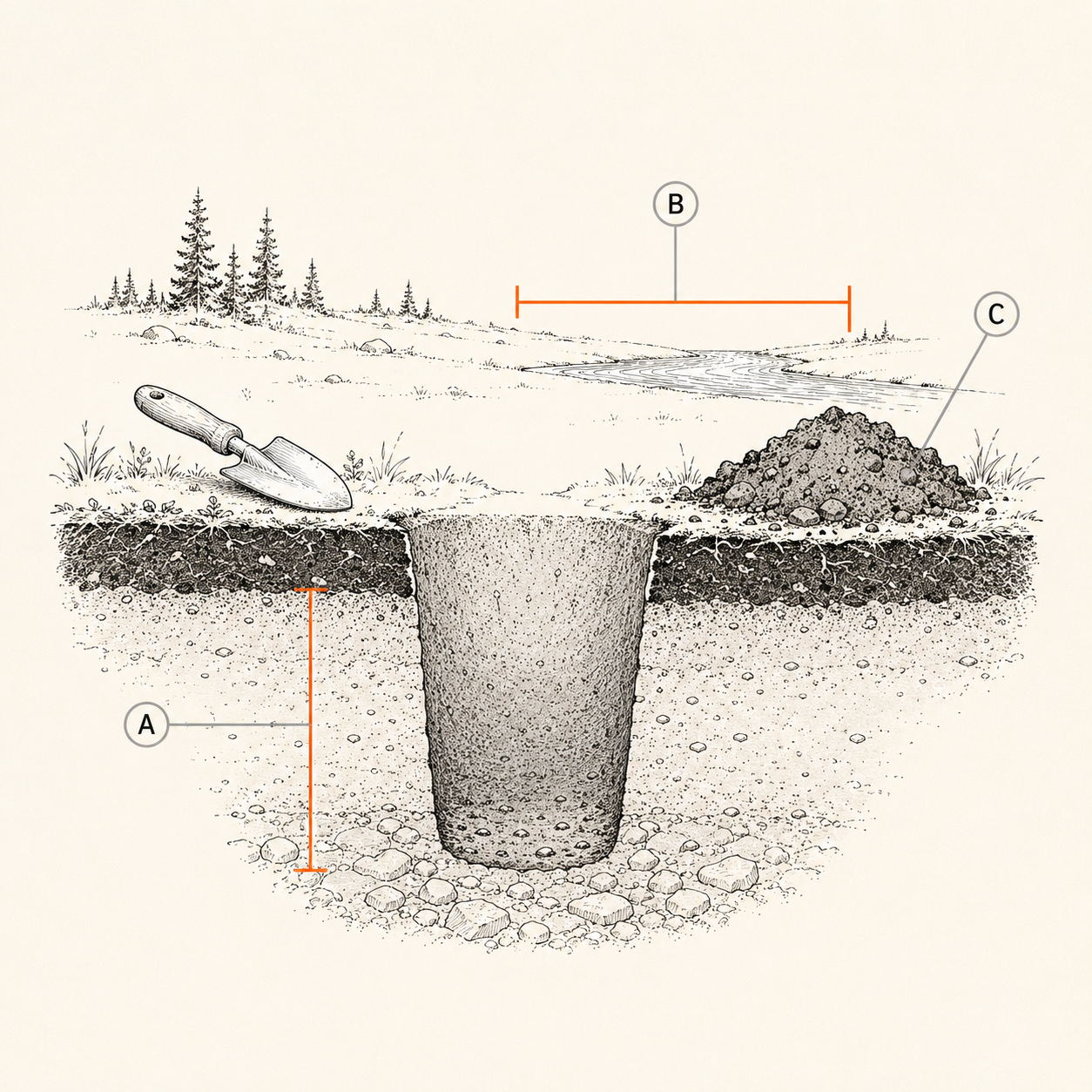
Dig a cathole 6 to 8 inches (15–20 cm) deep and 4–6 inches (10–15 cm) wide, at least 200 feet (about 70 steps) from any water, trail, or campsite, in organic soil if possible. A lightweight trowel makes this easy.
The steps:
- Choose a spot 200 feet from everything. At least 200 feet (about 70 adult steps) from water sources, trails, and camp. Pick an inconspicuous site with deep, organic soil (which breaks waste down faster), under forest duff is ideal. A little uphill from camp, somewhere you won’t be seen.
- Dig the hole. Use a lightweight backpacking trowel (a few ounces, worth every one) to dig down 6–8 inches (15–20 cm), deep enough that waste is well buried but still in the biologically active topsoil layer, and 4–6 inches (10–15 cm) across. Keep the dug-out dirt in a pile beside the hole.
- Do your business into the hole. (The squatting position takes a little practice, you can brace against a tree or rock, or hold onto trekking poles for balance.)
- Fill and disguise. Pack your used toilet paper out (next section, do not bury it). Fill the hole completely with the original dirt, tamp it down, and disguise the spot with leaves, needles, or a rock so it looks undisturbed. Well-done, no one will ever know.
Packing Out Toilet Paper
Pack out your used toilet paper in a sealed bag rather than burying it, buried TP gets dug up by animals and doesn’t break down quickly, and burning it is a fire risk. A doubled zip-top bag (optionally with a bit of tape or foil on the outside so you can’t see in) carries it out invisibly.
This surprises beginners, but it’s the current best practice: buried toilet paper doesn’t stay buried, animals dig it up, and it decomposes slowly, so it ends up scattered on the surface for the next person to find. And burning it is a serious wildfire risk (and often illegal). So the standard is to pack it out: use minimal TP, put the used paper in a sealed bag (double-bag it, and many people wrap the outer bag in tape or foil for opacity and odor), and carry it out with your trash. It’s less gross than it sounds, sealed away, you forget it’s there until you dispose of it at the trailhead. Alternatives some hikers use: natural materials (smooth stones, snow, with care) reduce or eliminate TP, and a small backcountry bidet (a squeeze bottle of water) cuts TP use dramatically. And pack out used hygiene products (tampons, pads, wipes) the same way, sealed and carried out, never buried or burned.
Peeing Responsibly
Urine is relatively harmless, so peeing outdoors mainly requires getting away from camp and water and being discreet, but aim for durable surfaces and, in some sensitive areas, know that even urine has considerations. Walk a bit off the trail, away from water, and go.
Urinating is far simpler than the other business: urine is essentially sterile and doesn’t pose the same contamination risk, so the rules are lighter. Just step off the trail, away from water sources and camp, and be discreet. A few refinements: aim for durable surfaces (rock, gravel, dirt) rather than fragile plants, in some areas the salt in urine draws animals to nibble vegetation, so bare ground is kinder. In sensitive alpine or desert environments, follow any local guidance. People who squat to pee may find a pee cloth (a dedicated small cloth, tied to the pack to dry and rinsed occasionally) or a pee rag/bidet more comfortable than TP, or use a pee funnel to stand, personal preference. None of this is complicated; the main point is get away from water and camp, and go on durable ground.
Staying Clean on the Trail
Stay reasonably clean with minimal-impact methods: hand sanitizer (especially before eating and after bathroom trips), a bandana or wipes for a quick wash, and washing your body and dishes at least 200 feet from water using little or no biodegradable soap. You won’t be spotless, and that’s fine.
Backcountry hygiene is about health more than sparkle, you accept being a bit grubby, but you manage the germs that actually matter. The essentials:
- Hand hygiene is the important one: use hand sanitizer after every bathroom trip and before handling food. Poor hand hygiene, not the water, causes a lot of backcountry gastrointestinal illness, this single habit prevents most of it.
- Body: a quick wipe-down with a bandana dampened with treated water, or wet wipes (packed out, they don’t decompose), keeps you fresh enough. For a real wash, do it 200 feet from water with minimal or no biodegradable soap, and scatter the wash water widely on the ground, never wash directly in a lake or stream (even biodegradable soap harms aquatic life in the water).
- Teeth: brush 200 feet from water, use a tiny bit of toothpaste, and spread the spit widely rather than spitting into water.
- Dishes: wash 200 feet from water, use minimal biodegradable soap, strain out food bits and pack them out with trash, and scatter the strained water. Better yet, cook and eat in a way that leaves little to clean (eat from the pouch).
Safety Hand hygiene after bathroom trips and before eating is genuinely the most important illness-prevention habit in the backcountry, more than water treatment for many hikers. Carry hand sanitizer and use it religiously. Backcountry stomach bugs are frequently traced to hands, not water.
Special Situations and Etiquette
Handle special situations with the same principles scaled up: in fragile or high-use areas pack out solid waste, manage menstruation and medical needs by packing everything out, and always prioritize keeping water sources clean. The underlying ethic is simple respect for the land and the next person.
A few situations need extra care. In fragile or heavily used areas (deserts, alpine, canyons, popular spots, river corridors), catholes may be prohibited and you must pack out solid waste in a WAG bag, check and comply. Menstruation in the backcountry is entirely manageable: pack out all used products in sealed bags (as above), keep hands clean, and consider a menstrual cup as a lower-waste option some prefer. Medical needs (medications, conditions), plan ahead and pack out all related waste. Group hygiene matters more with more people: designate practices so everyone follows them, especially hand hygiene, since illness spreads fast in a group. And the etiquette constant: keep it away from water, keep it out of sight, and pack out what should be packed out. Treat the backcountry as you’d want to find it, because someone will find it after you.
Trail Notes
- Poop in a cathole: 200 ft (~70 steps) from water/trail/camp, dig 6–8 in (15–20 cm) deep, bury and disguise. Some areas require packing it out (WAG bag), check.
- Dig catholes in deep organic soil with a light trowel; keep the dirt pile to refill and disguise.
- Pack out toilet paper (sealed bag), don’t bury (animals dig it up) or burn (fire risk). Same for hygiene products.
- Peeing is low-risk: get away from water and camp, use durable surfaces, be discreet.
- Hand sanitizer after bathroom and before eating is the #1 illness-prevention habit. Wash body/dishes/teeth 200 ft from water with minimal soap.
- In fragile/high-use areas, pack out solid waste. Keep everything away from water and out of sight.
Rookie Mistakes
- Going too close to water. It contaminates the source everyone drinks from. 200 feet minimum, always.
- Burying toilet paper. Animals dig it up and it lingers. Pack it out in a sealed bag.
- Skipping hand sanitizer. Dirty hands cause most backcountry stomach bugs, more than untreated water. Sanitize every time.
- Washing or spitting directly in a lake or stream. Even biodegradable soap harms the water. Do it 200 ft away and scatter the water.
- Not carrying a trowel. Scratching a shallow hole with a stick leaves waste too shallow to break down. Carry the few-ounce trowel.
FAQ
How do you poop in the woods? Walk at least 200 feet (about 70 steps) from water, trails, and camp; dig a cathole 6–8 inches (15–20 cm) deep with a trowel; do your business into it; then fill it with the original dirt and disguise the spot. Pack out your used toilet paper in a sealed bag. In some fragile or high-use areas you must pack out solid waste in a WAG bag instead, check local rules.
How deep should a cathole be? About 6 to 8 inches (15–20 cm) deep and 4–6 inches (10–15 cm) wide, deep enough to bury waste well but shallow enough to stay in the biologically active topsoil, where soil organisms break it down. Dig it at least 200 feet from water, trails, and camp, ideally in dark organic soil, and fill and disguise it completely afterward.
Do you have to pack out toilet paper when backpacking? In most places, yes, it’s the current best practice. Buried toilet paper gets dug up by animals and decomposes slowly, and burning it is a wildfire risk. Use minimal TP, seal it in a doubled zip-top bag (many people make the outer bag opaque), and pack it out with your trash. Pack out hygiene products the same way.
How do you stay clean while backpacking? Manage the hygiene that matters: use hand sanitizer after every bathroom trip and before eating (this prevents most backcountry illness), wipe down with a damp bandana or packed-out wipes, and do any real washing at least 200 feet from water with minimal biodegradable soap, scattering the water. Brush teeth and wash dishes the same distance from water. You’ll be a bit grubby, that’s normal and fine.
Where do you pee when backpacking? Step off the trail, away from water sources and camp, and go discreetly, urine is essentially sterile, so the rules are lighter than for solid waste. Aim for durable surfaces (rock, gravel, bare dirt) rather than fragile plants, since salts in urine can draw animals to nibble vegetation. In sensitive alpine or desert areas, follow local guidance.
Read offline
The whole book as one PDF — every chapter, every diagram.