Chapter 22
When the Sky Turns
Cold, heat, lightning, altitude
The environment itself is the backcountry’s most serious hazard, not bears or cliffs, but cold, heat, lightning, and thin air. These are also the most manageable dangers, because they’re predictable and largely preventable with knowledge and preparation. This chapter teaches you to recognize each one early and respond correctly. Read it carefully; the information here has saved lives, and none of it is complicated.
Hypothermia: The Deadliest Common Hazard
Hypothermia, a dangerous drop in core body temperature, is the leading environmental killer of hikers, and it does not require winter. It strikes in cool, wet, windy conditions well above freezing, when your body loses heat faster than it makes it. Recognize it early and prevent it, because it impairs the judgment needed to save yourself.
Hypothermia is the hazard this whole book has been quietly guarding against, it’s why “cotton kills,” why the rain shell rides in the pack on sunny days, why you keep a dry layer sacred. It sets in when heat loss outpaces heat production, and its favorite conditions aren’t arctic, they’re wet, windy, and cool (40s–50s °F / single digits Celsius), where a soaked, tired hiker chills fast. Wetness (rain or sweat), wind, and exhaustion are the accelerants.
The cruelest feature is that hypothermia impairs judgment, a cold person often can’t recognize their own condition or make good decisions, which is why hiking partners must watch each other. Learn the progression:
- Mild: shivering, cold hands and feet, slight loss of coordination, and the classic warning sign hikers remember as the “umbles”, stumbling, mumbling, fumbling, grumbling. Someone getting clumsy, slurring, dropping things, or turning irritable and withdrawn may be going hypothermic.
- Moderate: violent shivering, obvious confusion, slurred speech, stumbling, poor decisions (like removing clothing, “paradoxical undressing”).
- Severe: shivering stops (a dangerous sign, not a good one), muscles stiffen, consciousness fades; this is life-threatening.
Catch it at the “umbles” and it’s easily reversed. Let it progress and it becomes an emergency.
Preventing and Treating Hypothermia
Prevent hypothermia by staying dry, warm, fed, and hydrated, the core habits of this whole book. Treat it by acting immediately at the first signs: get the person warm and dry, out of wind and wet, into insulation, and give warm food and drink. For severe cases, handle gently and evacuate.
Prevention is everything you’ve already learned: stay dry (non-cotton layers, rain shell on before you’re soaked, change out of wet clothes), stay warm (layer up before you chill, especially when you stop), keep fueled and hydrated (your body needs calories to make heat), and know when to bail, descend, shelter, or turn back before conditions overwhelm you. Watch your partners for the umbles.
Treatment, at the first signs:
- Stop the heat loss. Get the person out of wind and rain, into a tent, shelter, or behind a windbreak. Replace wet clothing with dry.
- Add insulation. Get them into a sleeping bag and onto an insulating pad (crucial, the ground steals heat). Insulate from beneath, not just above.
- Add warmth and fuel. Warm (not scalding) sweet drinks and high-energy food give the body fuel to rewarm. Skin-to-skin contact in a shared sleeping bag adds warmth for a chilled person.
- For severe hypothermia (shivering stopped, confusion, stiffness): handle very gently (rough movement can trigger cardiac arrest in a severely hypothermic person), insulate thoroughly, and evacuate / call for rescue immediately, this is a life-threatening emergency needing professional care.
Safety The old advice to rewarm someone by having them exercise, or to give alcohol, is wrong, both worsen hypothermia (exertion drives cold blood to the core; alcohol increases heat loss). Never give alcohol. And never assume someone acting confused or clumsy in cold, wet conditions is just tired, treat for hypothermia. Acting early, while they can still help themselves, is far easier than treating a severe case.
Heat Illness: Exhaustion and Heatstroke
Heat illness ranges from heat exhaustion (heavy sweating, weakness, nausea, dizziness, serious but treatable) to heatstroke (a life-threatening emergency where the body’s cooling fails, marked by very high temperature, confusion, and often hot dry skin or collapse). Know the difference, because heatstroke kills fast and needs immediate cooling and evacuation.
At the hot end of the spectrum, the danger inverts. Heat exhaustion develops as you overheat and dehydrate: heavy sweating, weakness, fatigue, headache, nausea, dizziness, and cool clammy skin. The person feels awful but is still sweating and mentally intact. Treat it by stopping, getting into shade, resting, drinking fluids with electrolytes, cooling off (loosen clothing, wet the skin, fan), and not continuing until recovered. Caught here, it resolves.
Heatstroke is the emergency it can become, and it’s a true medical crisis: the body’s cooling system fails, core temperature soars dangerously, and the brain is affected. Signs: very high body temperature, altered mental state (confusion, agitation, slurred speech, loss of consciousness), and skin that may be hot and dry (sweating has stopped), though in exertional heatstroke the person may still be sweating, so don’t rely on dry skin alone; confusion or collapse in the heat is heatstroke until proven otherwise.
Safety Heatstroke kills within minutes to hours without treatment. It is a call-for-rescue emergency. While waiting: move the person to shade, cool them aggressively and immediately, douse or immerse in water, apply wet cloths to the neck, armpits, and groin, fan continuously, and evacuate. Rapid cooling is the priority; every minute at extreme temperature causes damage. Do not wait to see if they improve.
Prevention of both: hike in cooler hours in extreme heat, drink plenty with electrolytes (Chapter 17), wear sun-protective clothing and take shade breaks (Chapter 2), pace conservatively, and turn back from dangerous heat. Dehydration is the on-ramp to both, stay ahead of it.
Lightning Safety
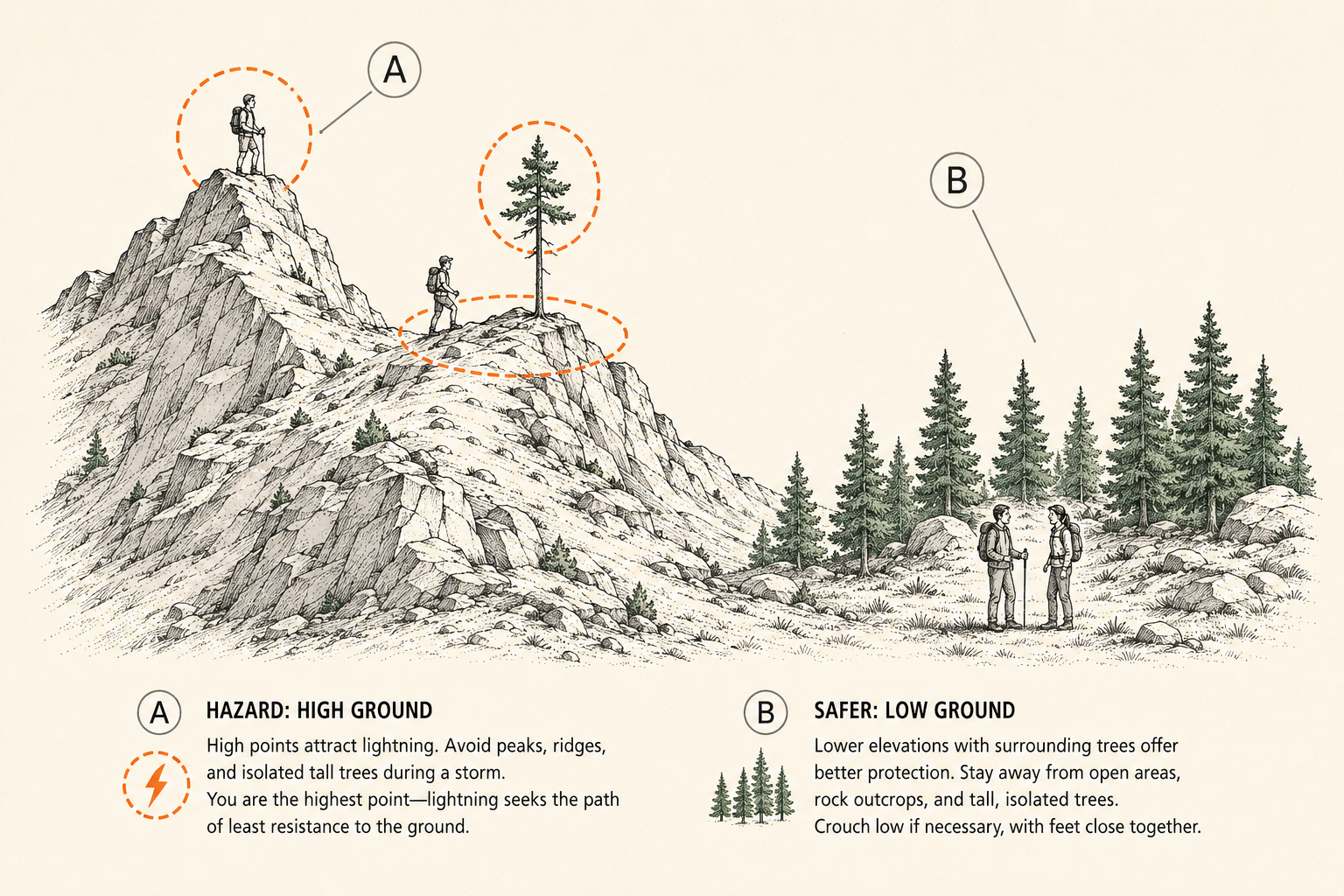
Lightning is a serious mountain hazard, especially in summer afternoons when thunderstorms build over high terrain. The rule is avoidance: when thunder roars, there is no safe place outside, so plan to be off exposed high ground before storms develop, and if caught, minimize your risk immediately.
Lightning kills hikers every year, and the modern guidance from weather authorities is blunt: no place outdoors is safe during a thunderstorm. You cannot make yourself safe in the open, you can only reduce risk and, far better, avoid exposure through timing. The key facts:
- If you can hear thunder, you are close enough to be struck. The moment you hear thunder, you’re in danger and must act.
- The 30-30 guideline: if the time between a lightning flash and its thunder is 30 seconds or less, the storm is within striking range, seek better shelter. Wait at least 30 minutes after the last thunder before returning to exposed terrain.
- Timing is your best defense. In ranges where afternoon thunderstorms are common (many mountains in summer), plan to summit early and be below treeline and off exposed ridges and peaks by early afternoon, before storms typically build. This single habit prevents most dangerous exposure.
If caught in a lightning storm with no real shelter (a substantial building or hard-topped vehicle is the only true safety, rarely available in the backcountry), reduce your risk: get off high ground, descend from peaks and ridges immediately; avoid being the tallest object and avoid lone tall trees, open fields, and water; avoid metal (drop metal-framed packs and poles a short distance away); spread your group out (so a single strike can’t injure everyone); and shelter in lower, uniform areas, a stand of similar-height trees in a low spot is better than a lone tree or an open ridge. If you’re in the open with a strike imminent, the last-resort position is to crouch low on the balls of your feet, minimizing contact with the ground, but understand this only marginally reduces risk and is not “safe.” The real answer is always to have descended before it came to this.
Altitude Sickness
At high elevation (generally above 8,000 feet / 2,400 m), the thin air can cause altitude sickness, most commonly acute mountain sickness (AMS), with headache, nausea, fatigue, dizziness, and poor sleep. It’s driven by ascending too fast, not by fitness, and it can progress to life-threatening forms if ignored.
As you climb, the air holds less oxygen, and if you ascend faster than your body can adapt, altitude illness results. Acute mountain sickness (AMS) is the common form, typically appearing above about 8,000 feet (2,400 m) in the unacclimatized: headache (the hallmark), plus nausea, loss of appetite, fatigue, dizziness, and trouble sleeping, often described as feeling hungover. Crucially, AMS is about ascent rate, not fitness, fit young athletes get it too; being in shape offers no protection against climbing too high too fast.
Two rare but deadly forms can develop if AMS is ignored and you keep ascending:
- HAPE (High-Altitude Pulmonary Edema): fluid in the lungs, extreme breathlessness (even at rest), cough, chest tightness, and severe fatigue.
- HACE (High-Altitude Cerebral Edema): swelling of the brain, confusion, loss of coordination (unable to walk a straight line), severe headache, and altered consciousness.
Safety Both HAPE and HACE are life-threatening emergencies. The treatment for both is the same and immediate: descend, now. Losing even 1,000–3,000 feet (300–900 m) of elevation often brings rapid improvement. Never ascend with symptoms of altitude illness, and never leave someone with worsening symptoms alone. Descent saves lives; waiting costs them.
Preventing Altitude Sickness
Prevent altitude sickness by ascending gradually to let your body acclimatize: above about 10,000 feet (3,000 m), increase your sleeping elevation by no more than about 1,600 feet (500 m) per day, take a rest day every 3,000 feet (1,000 m) or so, “climb high and sleep low,” and stay hydrated. If symptoms appear, don’t go higher until they resolve, and descend if they worsen.
Acclimatization is the whole game, and it just takes time and a gradual profile:
- Ascend gradually. The core rule for higher elevations (above ~10,000 ft / 3,000 m): don’t increase your sleeping altitude by more than about 1,600 feet (500 m) per night, and take a rest day (sleep at the same elevation) every 3,000 feet (1,000 m) or so of gain. Below those elevations you have more latitude, but the principle, go up gradually, always holds.
- “Climb high, sleep low.” You can hike to a higher elevation during the day, but return lower to sleep, your body acclimatizes best based on sleeping altitude. This is why day hikes to altitude with a lower overnight are much gentler on you.
- Spend a night at moderate altitude before going higher, if you’re coming from low elevation. A night or two around 8,000–9,000 feet (2,400–2,750 m) markedly reduces AMS risk on a subsequent higher climb.
- Stay hydrated, eat well, avoid alcohol, and don’t over-exert on arrival at altitude. Rest the first day.
- Respond to symptoms: if you get AMS, stop ascending and rest at that elevation until it resolves; if it doesn’t improve or gets worse, descend. Never push higher with symptoms.
Prescription medication (like acetazolamide) can help prevent and treat AMS for those going to significant altitude, worth discussing with a doctor before a high-elevation trip. But the foundational prevention is simply patience: give your body the days it needs to adjust.
Sun and Other Exposure
Protect against the sun at all elevations, and especially up high where UV is far more intense, sunburn, snow blindness, and sun-worsened dehydration are all preventable. Cover up, use sunscreen, and wear real sunglasses.
The sun is a slower hazard but a real one, and it intensifies with elevation: UV radiation increases roughly 10–12% per 1,000 meters of altitude, and reflects powerfully off snow, water, and pale rock, so mountain and snow travel can burn you shockingly fast, even on cool or hazy days. Protect yourself with the Chapter 2 kit: sun-protective clothing (long sleeves, brimmed hat), sunscreen (SPF 30+, reapplied), and quality sunglasses with full UV protection (essential on snow, where snow blindness, painful, temporary UV burn of the eyes, is a genuine risk; consider glacier glasses for extended snow travel). Sunburn also impairs your body’s cooling and adds to dehydration, compounding heat risk. None of this is dramatic, but a bad burn or snow blindness can ruin a trip and worsen other hazards. Cover up, especially high and on snow.
Trail Notes
- Hypothermia (deadliest common hazard) strikes in cool, wet, windy conditions, not just winter. Watch for the “umbles”; it impairs judgment. Stay dry, warm, fed. Treat early: dry, insulate (including underneath), warm drinks. Never give alcohol; severe cases handle gently and evacuate.
- Heat exhaustion (sweating, weak, clammy) → rest, shade, fluids, cool down. Heatstroke (confusion, very hot, may be dry skin) is a kill-fast emergency → cool aggressively and evacuate now.
- Lightning: no place outside is safe. Be below treeline and off peaks/ridges by early afternoon. If thunder, act; wait 30 min after the last thunder. Descend, avoid tall lone objects and metal, spread the group out.
- Altitude sickness (AMS: headache, nausea, fatigue) is about ascent rate, not fitness. HAPE/HACE are deadly, descend immediately. Above ~10,000 ft, sleep no more than ~1,600 ft (500 m) higher per night; rest day every ~3,000 ft; climb high, sleep low.
- Sun intensifies at altitude and reflects off snow, cover up, SPF 30+, real UV sunglasses; snow blindness is real.
Rookie Mistakes
- Thinking hypothermia needs winter. It kills most often in cool, wet, windy weather above freezing. Respect the 45°F rainy day.
- Missing the umbles. Stumbling, mumbling, fumbling, grumbling in the cold is the early warning. Act on it before judgment fails.
- Pushing over a summit as afternoon storms build. Be down off exposed ground by early afternoon. The peak isn’t worth a strike.
- Ascending with a headache and nausea at altitude. That’s AMS; going higher risks deadly HAPE/HACE. Stop, rest, descend if it worsens.
- Underestimating mountain and snow sun. UV soars with elevation and reflects off snow. Burn and snow blindness are preventable, cover up.
FAQ
What are the symptoms of hypothermia? Early (mild) hypothermia shows as shivering, cold extremities, clumsiness, and the “umbles”, stumbling, mumbling, fumbling, and grumbling as coordination and judgment slip. As it worsens: violent shivering, confusion, slurred speech, and poor decisions. In severe hypothermia, shivering stops (a dangerous sign), muscles stiffen, and consciousness fades. It can develop in cool, wet, windy conditions well above freezing.
How do you treat hypothermia in the field? Act at the first signs: get the person out of wind and wet, replace wet clothes with dry, and insulate them well, into a sleeping bag and onto a pad, since the ground steals heat. Give warm sweet drinks and high-energy food. Never give alcohol or make them exercise. For severe cases (shivering stopped, confusion, stiffness), handle gently and evacuate or call for rescue immediately.
What’s the difference between heat exhaustion and heatstroke? Heat exhaustion is serious but treatable: heavy sweating, weakness, nausea, dizziness, and cool clammy skin, with a clear mind. Rest, shade, fluids, and cooling resolve it. Heatstroke is a life-threatening emergency: the body’s cooling fails, temperature soars, and mental state changes (confusion, collapse), skin may be hot and dry. Heatstroke needs aggressive immediate cooling and evacuation; it kills within hours.
What are the symptoms of altitude sickness? Acute mountain sickness (AMS), the common form above about 8,000 feet (2,400 m), causes headache (the hallmark), nausea, loss of appetite, fatigue, dizziness, and poor sleep, like a hangover. Warning signs of the deadly forms: extreme breathlessness and cough (HAPE, lung fluid) or confusion and loss of coordination (HACE, brain swelling). Those require immediate descent.
How do you prevent altitude sickness? Ascend gradually so your body acclimatizes: above about 10,000 feet (3,000 m), raise your sleeping elevation no more than ~1,600 feet (500 m) per night, take a rest day every ~3,000 feet (1,000 m), and “climb high, sleep low.” Spend a night at moderate altitude first if coming from low elevation, stay hydrated, avoid alcohol, and never ascend with symptoms. Altitude drugs can help, ask a doctor.
Read offline
The whole book as one PDF — every chapter, every diagram.